
Elderly, frail have timeless task: to remember
Memorial Day looms. For some people, the weekend means action – camping, biking, hiking. They do not yet need the weekend for its real purpose – to remember, to mark, to mourn.
So it falls to the older and frailer ones, those who have lost almost all but memories, to draw us back to mortality, to point out that we are here just a limited time, even if we last 100 years.
Jerry Ray, of Spokane, is 70. He is chronically ill with many different things, yet he gathers his strength to give me a tour of memorials to dead people in and around Ralston, the town he grew up in. We meet at a gas station in Ritzville. He drives a black pickup. He asks me to follow him to the first memorial, because his black lab, Pepper, his most loyal companion, will not relinquish the front seat to a stranger.
I drive my car behind the pickup for nine miles southwest of Ritzville. This is Palouse country. The wheat fields are Kelly green. The chubby clouds look as if God manufactures them here and drifts them toward Hollywood for use in epic films.
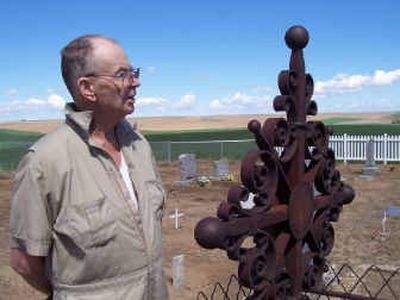
In the middle of this spectacular nowhere, we park at Salem Cemetery. Randy Roth stands in the cemetery. He is not so old. He is not frail. But he has embraced the task of remembering, because it is the right thing to do. A year ago, dismayed at the condition of the tiny cemetery, Roth asked fellow rural residents if they would work together to refurbish it. They agreed.
Established in 1899 by Palouse pioneers, the cemetery was part of Salem Evangelical Congregational Church, a church no longer there. Some of the grave markers are engraved in German. Many of the graves hold the remains of babies.
In the past year, residents built a vinyl picket fence. They weeded grass and reclaimed grave sites. Josh Knodel and his father, Jerry, created the metal-work cemetery entrance. The community effort will ultimately cost about $9,000; Ray and others have contributed financially. On Memorial Day, Salem Cemetery will be rededicated.
Ray thanks Roth for his hard work. Roth says of Ray, “He can’t physically do the work. But anything like this, he’ll support.”
Our next stop is three miles away in Ralston, where a flagpole and memorial honor area residents who died in World War II, including Reinhardt J. Keppler, a Medal of Honor recipient. There are also a Grange hall, grain elevators – and memories.
Ray’s parents owned the town’s grocery store. Now it is a private home. Ray would like to buy it back and end his days where they began. The retired educator has lived in Spokane County for two decades, but he has never really adjusted to Spokane’s impersonal feel. He longs for the time when neighbor looked after neighbor.
We next drive 18 miles to the school building in Washtucna. Fifty-four students, from kindergarten to 12th grade, attend school together here.
Last year, they lost one of their former students in Iraq. Army Spc. Blain M. Ebert died Nov. 22 in Baghdad. He was 22.
Donna Stoess, business manager for the school district, shows me the memorial being finished in front of the school. Ray and Stoess move their fingers over a plaque, placed in basalt rock, in Ebert’s honor. Ray paid for the plaque, as well as the new flagpole behind it. The memorial will be formally dedicated Friday.
Ebert’s father once leased farmland owned by Ray’s family, and Ray recalls the spring day when Blain Ebert turned 5. Fascinated with fire and action, the boy refused to leave the adults who burned thistles in the wheatfield stubble.
Stoess remembers Ebert as an eager Cub Scout in the den she led. Now he is gone from them forever, so fast, so young.
Our words fall away. The wind whips the flag atop the flagpole. The glorious clouds float by, worthy of heaven.
It is time to go, back to life. Stoess to her busy duties at the school. Me, to a frenetic newsroom. And Ray, back to his restless Pepper, back to this timeless task of longing and remembering.