
recycling with rik
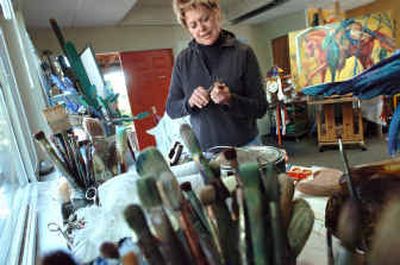
Imagine a fertile land where blue clematis climbs into the arms of the Man in the Moon, where you can see giant sugar peas as big as babies, where two hilarious cats, one wearing a pheasant-shaped hat, careen on an ancient rusted tricycle along a garden path.
Nope, not fantasy land. This is, in fact, artist Kay O’Rourke’s real yard and garden.
O’Rourke is primarily a painter, but for her yard and garden, she creates sculptures from discarded objects. For instance, the Man in the Moon is carved from scrap lumber. He hovers with the help of an old fan blade, in a garden plot where spinach now sprouts, soon to be joined by peppers, eggplant, tomatoes, broccoli and green onions.
Discarded packaging Styrofoam was the raw material from which O’Rourke shaped her super-sized sugar peas. She covered the Styrofoam peas with Drivet, an exterior acrylic stucco, then painted them with acrylics. Lightweight and durable outdoors, the peas are attached to truck-seat springs she found by the Spokane River.
“This sculpture is currently a trellis for my climbing sweet peas,” O’Rourke says, “and after they’re finished, they’ll be followed by a climbing pole bean.”
The grounds that surround O’Rourke’s home and studio are not only visually rich, but organically productive.
“I try to grow all my own food,” she says. “I come from a farm family. My soul and spirit are with things of the earth.
“I think of ‘property’ as a place where you incorporate everything you do on that piece of land back into it. Grass clippings and yard waste go back into the garden to compost. The garden gives me food. Then my chickens get my leftovers from the house and their droppings go back into my garden – and my neighbors’ gardens.
“When you ‘recycle’ like that, the earth enriches your life, and the lives of your children and friends and community,” she says. O’Rourke also participates in the Plant a Row for the Hungry which provides fresh vegetables to Second Harvest Food Bank pantries.
“I don’t have a lot of money,” O’Rourke says, “but anybody can grow things and enhance their life. You can be frugal, too, and reuse things. It’s healthy for the environment and respectful – absolutely respectful.”
O’Rourke finds treasures at local thrift stores and discount suppliers.
“I found an old burn barrel at Brown Building Supply,” she says. “It was all rusted and just beautiful. I use it as a planter for an alpine fir tree. The barrel cost maybe $5. At garden stores I’ve seen decorative containers like it sell for $150 to $300. I like to go to the back lot of St. Vincent’s on Trent and get things for 10- or maybe 25-cents. I’ve found some great stuff out there, like some old waffle irons I made into clocks.”
Once you get into the habit, it’s easy to see how common things can be used in unusual ways.
“Start looking,” O’Rourke encourages. “You’ll see ways to use things you threw away before. You’ll start buying less. Those silvery, weathered things you reclaim have a history. They’re old, used, abused, but you can help them go on and have a life that is wonderful. Plus, it’s really fun to create with materials that didn’t cost you anything.”