
New opal rush carries shades of Old West
SWEETWATER STATION, Wyo. – The scattershot markers of different sizes and colors stand out among the sagebrush with nothing more than a lonely, sauntering wild horse as far as the eye can see.
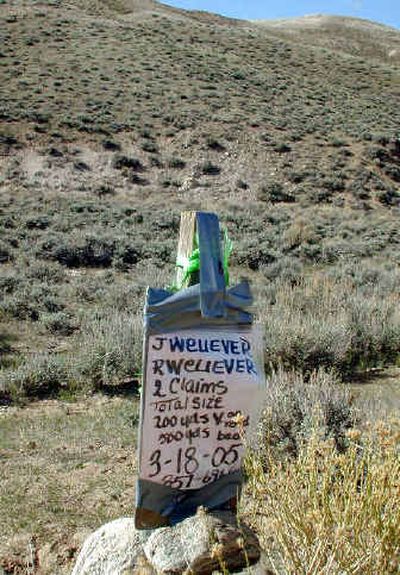
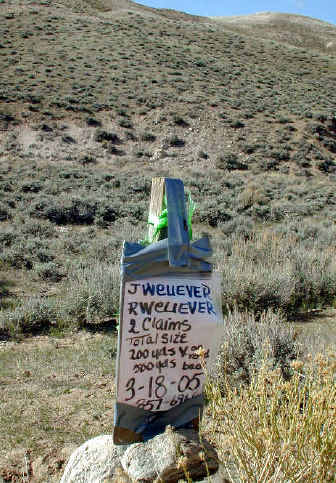
Over here is a 4-by-4 stake spray-painted pink and yellow; “Giddy Up and Go 3-4-05” is written in black marker on one side. Over there is another stake, bearing a clipboard bound with duct tape; written on the board: “2 claims Total Size 200 yds x 500 yds.”
Across a dirt-and-gravel road is a 2-by-4 stake, with “Discovery Cor #23” written on two sides. A plastic freezer bag is attached near the top with duct tape. Inside is a folded document that describes the claim’s dimensions.
The markers are monuments to a 21st century rush of prospectors. They descended on this remote, hilly area in south-central Wyoming last March with grand hopes and dreams of striking it rich by finding a precious gemstone called opal.
The rush caught federal officials off guard, resulted in a bureaucratic paper jam that has delayed actual mining and prompted authorities to take measures to protect an endangered flower from being trampled.
Opal is considered the most colorful of all gemstones, and the best opal gems are more valuable than diamonds, fetching up to $10,000 a carat, according to the International Colored Gemstone Association.
The Wyoming opal site – a 3-square-mile area about 100 miles west of Casper – was initially discovered by a local rockhound who told the State Geological Survey, which undertook a more extensive survey and found large deposits of opal. Most of the opal is “common opal,” which isn’t worth much. But geologists found some of the highly valued “precious opal,” leading them to conclude that there was more to be found.
Fremont County Clerk Julie Freese said her office received 1,048 mining claims over a nearly two-month period after the State Geological Survey publicly announced the exact location of the opal deposit. Each claim cost $135 in fees.
“I thought it would be more; it didn’t seem too bad a price,” said Jim Montgomery of Cheyenne, who along with a partner staked two claims – named “Mother Lode” and “Lucky Strike” – for a total of $270.
“We went up and kind of picked around a little bit, but didn’t find anything too exciting yet,” Montgomery said.
Unlike the gold rushes of Old West lore, these new prospectors aren’t allowed to begin digging until their paperwork is properly filed with the state and the U.S. Bureau of Land Management, which manages most of the land where the opal is located.
So far, the Wyoming BLM office in Cheyenne has received only 50 of the 1,048 claims. And even among those 50, most lack the proper legal description in order to be accepted, further delaying the digging.
“They’ll all be getting letters asking them to correct the legal description,” said Pam Stiles, a land law examiner with the BLM.
While the paperwork has put a clamp on actual digging for now, the rush to the 1,680-acre area certainly wasn’t lacking for adventure, surprise and some comic relief.
The BLM was caught off guard because the State Geological Survey kept the exact location of the deposit secret until a public announcement March 4. Jack Kelly, manager of the BLM office in Lander, had to call in help from other BLM offices around the state to handle the onslaught of prospectors.
W. Dan Hausel, a state geologist in charge of metals and precious stones, said the state office didn’t want to chance a leak that would have given some prospectors an unfair head start and didn’t anticipate environmental problems because an oil field is located in the same area.
But the BLM was forced to restrict vehicles on 360 acres in the area because some prospectors were driving off roads and endangering the desert yellowhead, a sunflower-like plant listed as threatened under the Endangered Species Act. Some deep wheel ruts were gouged into the ground.
“It’s going to have to heal over time,” Kelly said.
Hausel recalled that some prospectors, acting on early news reports, had positioned colleagues with satellite telephones in the general area of the deposit so they could get a jump on others when the exact location was announced.
Hausel said he found the initial interest and rush both surprisingly strong and amusing. The Geological Survey received hundreds of phone calls in the weeks after announcing the deposit, he said.
“It was quite a rush, and 99 percent of the people I talked to had no idea what they were doing, so it was pretty entertaining,” Hausel said.
Some people ended up miles away from the opal because “they didn’t know how to read a map,” he said. Many had no clue about mining regulations and how to stake a claim.
Kelly said he expects prospectors to start digging on their claims this summer and into the fall before winter forces a halt.