
Under stress
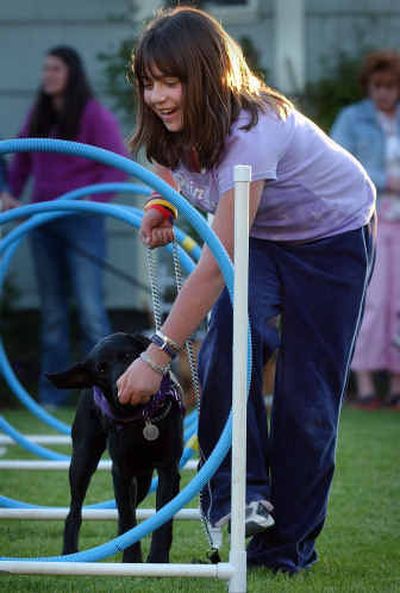
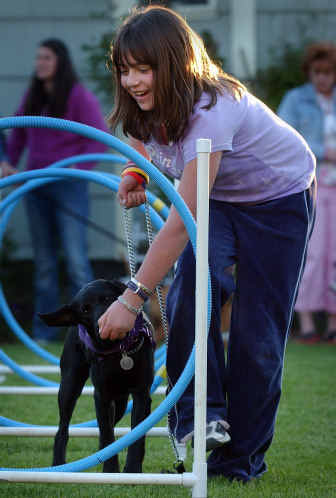
Young children tend to squeal, laugh and shout while playing. The combination of noise and activity can overwhelm a dog and send it to the corner to hide. A child who pursues the dog to play may get bitten.
Almost all dog bites can be traced to stress and a lack of coping skills on the part of the dog, said animal trainer Lisa Lucas. “When a dog is stressed and doesn’t know what to do, it will bite and growl,” she said. “A lot of times they’ll back away instead of biting.”
But if a dog is in a position where it can’t get away, it will likely turn to its teeth. “They feel cornered.”
The most important thing for parents is not to leave their children alone with the dog, Lucas said. People tend to anthropomorphize their pets and forget that dogs are animals that communicate with their teeth, whether it’s by baring them or nipping and biting. “I think we’re a little bit of a victim of the Lassie and Rin Tin Tin myth.”
Heather Olson knows that things can go wrong in a heartbeat. Her nephew, 5-year-old Isaiah Bayles, was recently bitten in the face by a neighbor’s dog that Isaiah had been around before. He had 13 stitches on his cheek, and a gash under his eye had to be glued shut because it was too close to the eye to be stitched, Olson said.
It’s unclear why the dog bit. An adult in the room had her back turned and Isaiah isn’t sure what he was doing right before the dog bit. His 9-year-old cousin reported that Isaiah tried to grab the dog’s bone.
“There’s a lot of face bites in kids because they’re short,” said Nancy Hill, director of Spokane County Regional Animal Protection Service. “They’re right at mouth level.” Young children also are less apt to realize that a dog is getting upset.
So what’s a parent and dog owner to do? The answer is one word: Socialize. “The most significant thing we can do is to get the dog socialized to children prior to (age) 16 weeks,” said Lucas.
Puppies need to be exposed to a wide variety of children. They need to hear the noises children make and feel small hands on their fur. Dog owners who don’t have children of their own can take the puppy to an elementary school and let it sit and observe children while they are playing. If the puppy begins to show signs of stress – trembling, tail tucked between the legs and the urge to run away – remove it from the situation.
Socialization isn’t very effective if done after the puppy is 16 weeks old. “If it’s not imprinted, the brain cannot assimilate it as well as an adult,” Lucas said.
A grown dog will give signals that it is becoming stressed. It will sometimes yawn or look away, whether it’s just the eyes or by turning the whole body. Fast panting in the absence of heat or exercise is also a signal of stress. “That’s when you want to separate kid and dog. If a child wants to pet a dog and it wants to go away, let it go away.”
There are some basic do’s and don’t when it comes to children interacting with pets. Children should help take care of the animals and can also participate in training. It’s not a good idea to let children hug dogs around the neck, which could make them feel trapped and confined. And children should never play tug-of-war with a dog. The dog will see the game as a way to assess who is dominant, the child or the dog. Adults can play the game as long as there are clear rules and the adult always wins.
“The dog can never win tug-of-war,” she said. “The kid will lose every time, and that will reinforce that the dog is on top.”
Children also tend to grab dogs’ skin, ears or tails. Adults can get a dog used to that behavior by tugging the tail and then giving the dog a treat. “Then the dog associates good things with a tail tug. Get them used to things a kid might do. A lot of times it’s the element of surprise that causes the dog to bite.”
Hill said she often sees families who have taught puppies to chase children as a form of play. It can be cute when they’re little, but once a dog hits 60 pounds, it’s no longer cute. Running, in addition to high pitched shouting and laughing, can also trigger the predatory instinct in dogs.
Hill said she remembers a case in Newman Lake when she was an animal control officer. A man was outside working on his car with his 10-year-old son. A dog was lying nearby. The boy spotted some friends down the road and ran toward them, shouting. “That husky just took off after him and jumped up and just took him down,” Hill said. “There was a big hole in his throat. It was that prey instinct. That prey thing is something not to be discounted.”
Hill said SCRAPS responded to 249 serious dog bites in 2004 in Spokane Valley, Millwood and unincorporated Spokane County, but the agency doesn’t track the age of the victims. National statistics show that men and boys are bitten twice as frequently as women and girls, said Hill, and 60 percent of dog bites involve victims under the age of 16.
“That’s all about body language and posturing,” she said. “Men are more threatening and have deeper voices that are perceived as growls.”
Lucas said that male dogs that have not been neutered are most likely to bite. Contrary to popular opinion, a dog that bites does not develop a taste for it.
“If a dog had never bitten before, it means it had never been pushed to its limit before,” said Lucas. “It doesn’t increase the probability that it will do it again, but it does give us information about how that dog will respond when pushed to the limit. Some dogs take forever to use their teeth, and some dogs use them quickly.”
Even if a dog bites, it can be taught to have what is called a soft mouth and not break the skin. In the animal world, it’s the job of female dogs to correct puppy behavior. One option is to bring a new puppy to visit an adult female, and if the puppy bites too hard while playing, the adult will correct it, said animal behaviorist Patricia Simonet.
But people can do the training themselves as well. “If teeth touch the skin, yelp and remove yourself from the dog,” she said. “The dog really wants your attention. Just walk away.”
Pet owners can also announce “You win” to the dog in a happy voice and then lock it in a crate until the dog calms down and is no longer barking or whining. Then the dog can be let out and allowed to play again. The dog will quickly learn that any biting will result in being locked away. “That’s sort of the human version of being a mama dog,” she said.
Puppies shouldn’t be separated from the litter before 8 weeks. “Puppies are learning bite inhibition in the litter,” Lucas said.
When a family goes to a shelter to adopt a dog, there’s generally no information about the dog’s early training or socialization. But the dog itself will give clues as to its temperament.
Kids should meet the dog in a quiet setting. A dog should approach the child from below head level, which is submissive behavior. Licking under the chin is good, but not directly in the face.
“Stiff and straight toward the child is not good,” Lucas said. “Ignoring the children is not a good sign. It indicates some level of discomfort. You want to see a happy tail (wag). You want to see the dog almost prefer to interact with the kids rather than the adults.”
It’s also a good idea for adults to check the dog’s temperament by giving an experimental tug on the dog’s tail or ears to check its reaction. “You can get a good adult dog.”