
Trial exposes elections system flaws
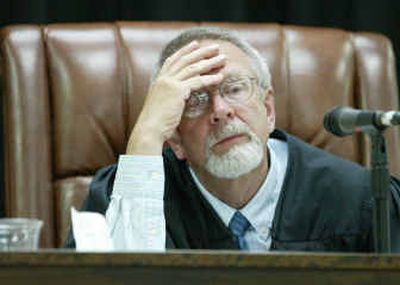
WENATCHEE – Determining the rightful occupant of the governor’s mansion is the ultimate goal of the legal battle playing out here, but the state’s electoral system is really what’s on trial.
If that is found wanting, it could be fixed. The question then might be: How much are we willing to spend?
Republicans started their case Monday by claiming that fraud played a hand in Christine Gregoire winning the second recount and being certified as governor instead of Dino Rossi. But they spent four days without producing a “smoking gun” as proof that ballots were stuffed into some precinct boxes for Gregoire and stolen from other precincts for Rossi.
Instead, they have evidence of problems in King County, which is where Gregoire built up a big enough vote total to offset Rossi’s leads in 33 other counties.
Now Democrats have an equal amount of time to convince Chelan County Superior Court Judge John Bridges that the GOP claims are just, in the words of their attorney Kevin Hamilton, “guessing and suspicions” about things that happen in the normal course of elections.
Democrats’ strategy may be summed up as adapting Murphy’s Law to read, “Stuff happens in places that lean Republican, too.”
Both parties are opening up a part of the electoral system that most people take for granted. For years, the emphasis on getting better elections has focused on the front end of the system, the part leading up to the point the ballot is dropped off.
Laws made it easier to register to vote, and easier to cast a ballot somewhere besides the neighborhood polling station. Parties spent millions on “get out the vote” drives, registering the unregistered in the months before the election and getting the registered to vote by Election Day.
In 2004, these things – combined with a competitive presidential contest and some other hot races – gave Washington state record registration numbers, record turnout and record numbers of absentee ballots to process, open and count.
Congratulations all around, until the governor’s race turned up with a margin as thin as a gnat’s wing.
The revote trial has pointed out, sometimes in excruciating detail, what happened after the votes came in. There was a lengthy discussion of “batch slips,” paper forms that track absentee ballots from the time they are picked up at the post office to the point where they are either ready to be counted or rejected. King County had more than 3,000 batch slips, absentee supervisor Nicole Way said, and each slip could be marked by different people at different stages as some ballots are pulled out for inspection or rerouting.
Some of the totals on some of the slips don’t add up. It’s up to Bridges to decide whether this is an example of election worker misconduct, as Republicans suggest, or simple human error, as Democrats contend.
But because many counties use temporary or part-time workers during the weeks around a big election, it’s clear that whatever caused the problem can happen again unless there is a switch to a different, and probably more expensive, level of staffing.
A new federal law, the Help America Vote Act, was designed to increase participation after problems in the 2000 election. Part of that law makes it easier for a voter who shows up at the wrong polling station to mark a “provisional ballot” that can be directed to the right location, whether across town, across the state or across the country. When it gets to the right place, the registration is checked, and if verified, the ballot is counted.
So if a Spokane voter found herself on an unplanned trip to Seattle last Nov. 2, she could have walked into a King County precinct, filled out an envelope with a form demanding name, address, date of birth and signature, and been given a local ballot. There was discussion in the trial about how different counties fill that out, what’s supposed to happen next, and how occasionally, something else happens.
Done the right way, that Spokane voter’s marks for the presidential and statewide races would have been counted over here, but races from U.S. House of Representatives and lower, if marked, would not.
Unless, of course, the voter just fed it into the polling station’s ballot counter or dropped it in the ballot box. That’s not supposed to happen, elections officials from around the state testified, but sometimes it does. It happened several hundred times in King County, but it also happened in Stevens, Benton, Walla Walla, Cowlitz, Island and Spokane counties. All but Cowlitz went for Rossi, Democrats pointed out.
When the provisional ballot arrives at its proper county, election workers are supposed to check a voter’s signature before counting it, just as they do an absentee ballot. Several county auditors said they checked the other information but didn’t do a comprehensive check on the autograph. Adams County Auditor Nancy McBroom said in her county’s only polling station, workers don’t check signatures but they do ask for a photo ID. That is, McBroom added, unless they know the voter personally.
That could be, as McBroom suggested, the best form of ID check. But it’s going to be increasingly hard to come by with a growing and mobile population.
And checking signatures, if absentee ballots are prone to being stolen from mailboxes, or purloined from the recently deceased and cast by someone else, might require more training or something more than the “three-point check” that some elections officials said their staffs use.
Partly because of federal law and partly because they need to modernize, many counties are upgrading the systems to track their voters or count their ballots. As extensive trial testimony explained, the two are not the same. In King County, the two are known only by their acronyms, DIMS for the voter registration system, and GEMS for the ballot counting system.
King County switched to DIMS last spring, and like any computer system ever installed in a large organization, the change was not without its problems or its detractors. When problems arose, there was a dispute between the computer geeks, who thought the system was fine and the humans were messing up, and the hands-on crews, who thought the blame should be reversed.
Anyone who ever worked in a business that switched from an outdated but familiar computer system to the “latest and greatest” hardware and software can probably relate to this argument. King County’s software was so new they had problems finding troubleshooters from other counties that also use DIMS, but older versions.
DIMS was supposed to help King County keep track of the absentee ballots going out and coming back. It didn’t do a complete job, and elections officials spent time on the witness stand explaining some of those problems. When it came time to compare the number of ballots DIMS was tracking with the number of votes counted, the numbers didn’t match up.
The trial has also pointed out a problem with the constant push to increase voter rolls, allowing registration by mail, over the Internet, or when getting a driver’s license. The state constitution doesn’t allow felons to vote unless they have their rights restored, but state law doesn’t allow county auditors to demand proof of a clean felony record. It’s enough to have a signed oath that the would-be voter believes he is eligible to vote.
Counties are notified of new felony convictions and remove those people from the books if they are registered. But elections officials testified they don’t – and under state law can’t – check a new voter for a criminal record before processing a registration.
That could be changed, just as identification rules could be tightened. But how much are voters, who are also taxpayers, going to be willing to pay for and put up with? Full background checks on the National Criminal Information System? Fingerprints? Retinal scans?
As witnesses pointed out repeatedly, once an illegal ballot gets into the machines with the legal ones, there’s no way to pull it out, no way to know if the illegal voter marked that ballot in any particular race, and no way to know which candidate in a near dead heat should have that vote subtracted from the total.
All of these flaws are fixable, and the Legislature passed some election reforms this year in the wake of the controversial recounts. But as the trial is demonstrating, previous election reforms like the Help America Vote Act may create a new problem in trying to solve an old one.
Without the narrowest margin in a statewide race in history, most of these problems would have gone unnoticed, and any discussion of batch slips, felon registration or voter crediting or DIMS would remain the stuff of seminar topics for local elections officials when they gather at conventions.
Because there’s never been a race this close with this much at stake, some might say Washington isn’t likely to go through this again, and election rules and processes don’t need a major change. With the flaws in the system exposed, however, some enterprising political operatives might have an easier time using them to their advantage.
Judge Bridges made clear last week that when he tries to match fact to the law and figure out who won last year’s election, he can’t take the attitude that a contestable race will remain an electoral blue moon.
“My focus here is based on a realization that this is going to happen again,” he said last week.