
Eclipse excites, offers terrific value
A young female friend is shopping for a new car. Judy’s a fashion-forward type, who dresses with an artsy, urban flair and wants a car to suit.
If the nearest Mini dealership weren’t located in Bellevue, she’d be tooling around town beneath a Union Jack by now. But 250 miles is too far to drive for an oil change.
Her dream car has two doors and is affordable — no Boxsters, Bimmers or Benzes on her dance card.
No roadsters, either, for reasons I haven’t parsed, taking out of play Mazda’s MX-5 Miata, Pontiac’s new Solstice and the Honda S2000.
Whatever’s left — Honda’s Civic coupe, VW’s New Beetle and GTI and a gaggle of entry-level Koreans — fail to make the cut, too, axed from consideration for one shortcoming or another.
Which leaves us with this week’s tester, the all-new, fourth-generation Mitsubishi Eclipse.
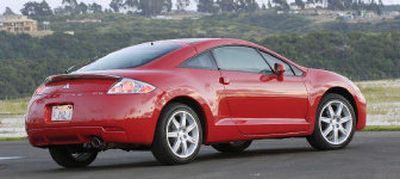
I would never have taken Judy for an Eclipse intender but she surprised me with her reaction the day I drove up in a vivid, copper-colored Eclipse GS.
It was as if she had finally found the perfect puppy.
I don’t know that she’ll end up in an Eclipse — Euro-chic is more her style, I think — but it’s telling that she’d find the appeal in the Eclipse, a car that has grown up in front of our eyes.
Early Eclipses — the car was introduced in 1990 — ran a peaky, turbocharged four-cylinder engine, offered all-wheel-drive, and earned a reputation as a young person’s performance car. By Gen-3, the all-wheel-drive version was history and the fire-breathing four had been swapped for a mild V-6.
The Eclipse remained an attractive, affordable and competent choice but the original platform had reached the end of the line and change was in order.
The new Eclipse is based on a familiar platform — it’s part of a three-vehicle squad called “Project America” designed specifically for the North American market. Its teammates are the midsize Galant sedan and the Endeavor crossover SUV.
Fitted to its new platform, the ‘06 Eclipse finds new purpose in life. It’s larger, more comfortable and, by consensus, better looking than its predecessors. Once prone to overstatement, it has matured into a graceful yet powerful form. Its curves are muscular, its roofline an elegant flow and its hindquarters a strong arc reminiscent of Nissan’s Z-car.
Even the obligatory spoiler appears of a piece with the balance of the design.
Although it falls short of the exterior’s high concept, the interior has been significantly improved, as well, starting with the seats, which are now well contoured and terrifically supportive. They’re patterned on the Recaros of racing fame, with serious side- and bottom-cushion bolsters, and for the most part the illusion works.
In virtually every aspect, the new Eclipse is accommodating of American-size folks. It’s 2.9 inches longer than last year’s car, 3.3 inches wider and 1.9 inches taller, most of which translates into more interior space.
There’s more room between the seat cushions and door panels and surrounding the instrument panel than on a full-size SUV we recently tested, and there’s head- and shoulder-room galore, though the back seat remains the domain of pets and infant seats.
Interior panels fit together well, with few of the unseemly gaps of yesteryear, and materials quality is much improved. The chrome-ringed gauges are a bit fussy, but easy enough to read. At night, they glow an icy blue.
If there is a complaint to be made about this interior, it has to do with the sight lines. The heavy rear quarter panels and thick C-pillar, which look so good from the outside, block the driver’s over-the-shoulder view. Even the base trim levels get power seats, with seat elevation adjustment, but this is an issue for full-size drivers and may be a showstopper for shorter folks.
The new Eclipse is available in two trim levels, GS (from $19,994, including destination) and GT ($24,494). The GS is powered by a 2.4-liter four that makes 162 horsepower and 162 foot-pounds of torque, while the GT gets a 3.8-liter six rated at 263 hp and 260 foot-pounds.
The GS is equipped with a five-speed manual, with a four-speed automatic available, while the V-6-powered GT is equipped with a six-speed manual box or optional five-speed automatic.
Front, side and curtain-style airbags are standard on both trims and disc brakes, backed by antilock functionality, are located at the four corners. Traction control is standard on the GT trim, but not available on the GS.
All Eclipses are well equipped. The standard-features list includes power windows, mirrors and locks; keyless entry; cruise control; air-conditioning; CD player; alloy wheels; spoiler; and split folding rear seats.
The Eclipse has put on about 300 pounds this year, but even so our GS tester felt spry and capable. It is said to be more nimble than the GT, whose six-cylinder power plant, with its cast-iron block, unbalances the car’s front-to-rear weight ratio. Urged into a quick turn, the GT responds with substantial oversteer.
The mission of the Eclipse leans toward “sporty,” not sport, though, and most drivers will find the ride and handling package exhilarating.
The Eclipse has always represented a terrific value for a certain kind of buyer — the evidence is all around if you take the time to notice — and is now a better value than ever.