
Judging the Gowans
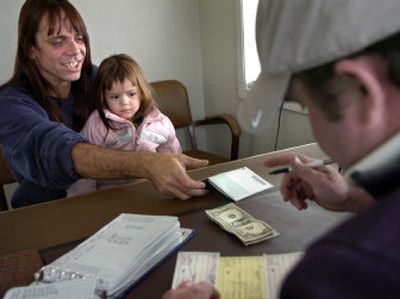
Having to pay for groceries with food stamps, sending their children off to school in worn and ill-fitting clothes, waiting months for much-needed surgery – none of poverty’s indignities hit Dale and Rebecca Gowan as hard as the letter to the editor that appeared in The Spokesman-Review in early September.
The couple, used to paying their own way through good times and bad, needed no reminder of their humiliation. Because of a work-related injury to Dale’s back, he could no longer provide for his wife and three children.
To the Gowans, it was bad enough having to depend on welfare and charity without reading in the newspaper that some people believe they have only themselves to blame for their misery.
“I was sympathetic after the first article written about the family. But each subsequent article just shows they haven’t done much to take care of themselves,” Peggy Smith of Spokane wrote in a Sept. 4 letter to the editor. “The taxpayers are about sucked dry!”
The Gowans have been the subject of a series of articles appearing throughout the year in The Spokesman-Review. Details about their lives and their efforts to escape poverty have evoked responses from readers ranging from financial help to harsh criticism of their lifestyle.
They came to Spokane in a worn-down school bus and wound up in an emergency shelter in January. By March, they had been accepted in the Salvation Army’s reduced-rent transitional housing program. In August, Dale finally saw a neurosurgeon who removed the herniated disk in his back.
Last month, Rebecca found work to support the family while Dale recovers.
To Smith and others who contacted the newspaper but chose to remain anonymous, decisions the Gowans have made about how they allocate their resources show serious errors in judgment. Spending money on Dale’s tobacco habit, buying the latest Harry Potter book, driving without insurance and taking a trip to Colorado this summer were all tallied against the family.
“I guess I have different priorities than what this family is portraying,” Smith said in an interview. “It’s judgmental on my part, but I think they could be making better decisions.”
Dale’s insistence on working as a drywall hanger, the only skill he has, bothered some readers because he has had to rely on Medicaid to repair the physical injury his profession caused him. Even newspaper photographs of Rebecca that showed her acrylic fingernails and dyed hair rubbed some readers the wrong way.
“If I had to cut back on something, that would be one area,” Smith said.
A few readers resented their tax dollars going to help the family. Dale, 38, has worked since childhood for employers, most of whom did not provide health insurance to their workers.
“Dale has worked for 24 years, paying taxes the whole time,” said Rebecca, 27. “He is injured and has to receive help for several months, and this is what people think of us.”
In March, after he further injured his back in a fall on the job, Dale was laid off by an employer concerned about the potential to cause the company’s state Labor and Industries rates to increase. Dale did not file a worker’s compensation claim. The employer read about his injury in The Spokesman-Review.
The Gowans were distraught by Smith’s letter to the editor after allowing the newspaper to put their lives under public scrutiny. Dale and Rebecca consented to the reporting in hopes their struggle would shed light on poor families who live in Spokane County, where the poverty rate of 13.7 percent is higher than that of the state as a whole (11.9 percent) or the nation (12.5 percent), according to the Department of Health and Human Services.
“Six months of writing, and she took only the bad things,” Rebecca said. “It was like she was saying, ‘Stop living, people,’ ” Rebecca said of her critic. “It was malicious. I didn’t choose to be here. I was forced into living here by circumstances. We have always been productive. Dale has always worked.”
The Gowans live on food stamps and $740 a month in federal Temporary Aid to Needy Families administered through the state Department of Health and Human Service. It is a fraction of what Dale used to make hanging drywall.
Dale and Rebecca did not stumble upon the letter to the editor by chance. It was shown to them by Dawn Kilmer, manager of the Salvation Army’s transitional housing program, after the family came up short on their subsidized rent for September.
“We all understand they made more money before,” Kilmer said. “They are trying to live with less. But if they don’t learn to manage money now, it’s going to be harder for them to manage when they do have an income.
“They really are doing things to help themselves. This is one area they need assistance on and they realize that.”
Families accepted into the Salvation Army program pay 30 percent of their gross income in rent, Kilmer said. The program also pays electricity. In exchange, adult family members must meet with a caseworker once a week and attend at least two life-skills classes a month in which they are taught how to budget.
“They want to find their own homes and take responsibility,” Kilmer said. “That’s the objective of this program, to help them become self-sufficient.”
As the letter about the Gowans pointed out, Kilmer said, the trip to Colorado “cost them money that they didn’t need to spend, which put them behind on their bills.”
In August, Dale and Rebecca agreed to drive an acquaintance to Colorado to pick up her boyfriend. They saw it as an opportunity to visit Dale’s brother in Loveland. Though the acquaintance paid for all the gasoline, the trip ended up costing the Gowans, whose vehicle broke down along the way.
“Sometimes people get into vicious cycles where they live from month to month,” said Kilmer, whose program is currently helping 22 families transition out of homelessness. “Then things come up like a car breaks down, or other unexpected expenditures, and instead of having a reserve, they spend that money on those emergencies. That takes away from necessary expenditures, like paying rent.”
The program teaches life skills to families while they are housed at the Salvation Army apartments in Spokane. Kilmer said caseworkers encourage families to pay ahead on rent and figure in the cost of food stamps and what they would be paying in utilities every month so that when they are earning a paycheck they are able to budget for such things.
“It’s just hard because when you are homeless, there are demands on the little amount of money you do have,” Kilmer said, citing things like keeping car tabs and insurance up to date. Often, she said, families in this situation end up pawning possessions to pay for gasoline to get to work.
There is also a lot of guilt involved in being homeless, particularly for families with children.
“Parents want to buy a treat for their kids. They feel like their kids have been going without and they want to treat them. I see a lot of guilt,” Kilmer said, especially among families who have come from emergency shelters.
Dale, who agonizes over his inability to provide for his family, pawned his wedding ring yet again to purchase the latest Harry Potter book. He dyed his wife’s hair for her from a box and could not begrudge her a $20 manicure, which he considers a small token to her self-esteem, which has suffered of late.
Far more numerous than the Gowans’ critics are the dozens of readers who called or e-mailed The Spokesman-Review and the Salvation Army wanting to help. Offers of furniture, dishes, clothes and other household goods came pouring in after an April story about the family appeared in the newspaper. One anonymous donor brought two sacks of groceries and $100 by their apartment.
But no individual donor has done more to help the family than Curt and Betty Chumbley, who twice in the past several weeks left envelopes for the Gowans containing hundreds of dollars worth of gift cards at the newspaper’s downtown offices.
“I know how they feel,” Betty Chumbley, 71, said. “We didn’t always have it easy either.”
She said she and her husband, members of Shadle Park Presbyterian Church, donate 10 percent of their income to charity because “the Bible tells us to.”
Chumbley dismissed criticism of the Gowans as overly harsh. “When people are down and out, sometimes they do foolish things,” she said. “They should have the Harry Potter book. He should give up smoking, though. I did.”
With the gift cards the Chumbleys gave them, Rebecca was able to buy back-to-school clothes for her oldest children, including a new warm coat for Anthony, 8, and boots for Madelynn, 7. In September, the children returned to Holmes Elementary School in Spokane’s West Central neighborhood. Though the family now lives outside the school’s boundaries, the Gowans chose to continue to bus their children to Holmes where teachers and administrators are used to handling students in similar situations. Nine out of 10 Holmes students qualify for free or reduced-price lunches.
Rebecca also bought new Levis and sneakers for Dale and work clothes for herself. With the gift cards, she stocked up on things food stamps won’t buy, such as cleaning supplies, soap and shampoo, a few pots and pans. Safeway cards allowed them to buy gasoline.
It is exactly how the Chumbleys, who have never met the Gowans, hoped the family would use their gift. Dale, Rebecca and their children wrote their benefactors notes of gratitude.
“Eventually,” Betty Chumbley said, “they should be able to work their way out of it.”
Last month, the family’s prospects were greatly improved when Rebecca landed a job with West Telemarketing, formerly Dakotah Direct, which provides customer services for other companies. She is making about $9 an hour while she trains with the company. After three months of continuous full-time employment, she will be eligible for benefits, including medical, dental and vision coverage.
Now that Rebecca has found work, the family will stop receiving its TANF grant at the end of November. Food stamps will continue for five months while she transitions into full-time work. Medicaid, the state and federal insurance program for low-income patients, will continue for one year. Dale and Rebecca, who never felt good about being on welfare, are looking forward to paying their own way again.
In July and August, Rebecca underwent eight weeks of office and clerical training through WorkFirst, the state’s welfare reform program that helps struggling families find jobs.
Rebecca’s success in finding a job came after months of looking for work, which was a condition of her family receiving financial help. Now, Dale drives her to work five days a week at 12:30 in the afternoon and picks her up each evening at 8. Driving to her downtown office, about a mile from the apartment, seemed safer to them and nearly as economical as riding the bus for $33 a month.
Recent magnetic resonance imaging of Dale’s back shows the August surgery to remove the herniated disk was successful, but he will have to undergo a series of epidural steroid injections and perhaps physical therapy before he can return to work.
He regrets having to wait nearly seven months to find a neurosurgeon to treat him. It was time he believes he could have spent recovering. As the pain in his lower back and legs gradually abates, he finds it more and more difficult staying home. But he knows that because of his medical history, prospective employers will require a release from his doctor.
“It’s been hard trying to keep him down this long,” Rebecca said in August. “Now there’s nothing left to do but heal.”
Though he has worked his entire adult life as a drywaller, he is coming to the realization that he will never be able to return to the profession. Rebecca has already come to terms with that reality. “He can’t go back,” she said. Eventually, he will have to be retrained in another profession.
While Rebecca looked for work, and now that she is working, Dale takes care of the couple’s 3-year-old daughter, Gillian. At first, because of Dale’s injury, the Gowans thought this would not be possible. Dale could not even pick up his daughter without wincing. The parents shopped around for state-financed day care, but could not bring themselves to leave her at any of the places they visited.
“A few might have been OK,” Rebecca said. “You hear so much about bad day cares. Gillian is so little, she couldn’t tell us if someone were mistreating her. Maybe when she is older.”
Despite his desire to return to work, Dale considers the past months he has spent with his daughter “a blessing.” On sunny fall days, he takes her to play in a park near their home.
“It’s the only good thing about being out of work,” he said.