
Pair to skate at national qualifier

It’s not as if training for a new scoring system and competing against an unknown field doesn’t cause enough jitters.
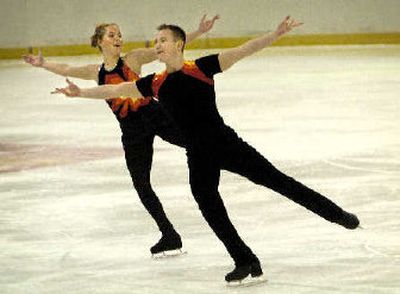
Figure skaters Kalie Budvarson and Chris Anders have another element of angst that’s been added to their routine as the Pacific Coast Sectional nears.
Where’s practice?
Since Planet Ice in Spokane Valley is in the process of being sold and is currently closed, the pair and coach Karin Kunzle-Watson feel as displaced as a Tahitian ski team. Until the red tape is ironed out between the new owner, the bank and a group of patrons with a vested financial interest, the Inland Northwest’s most accomplished figure skaters are scrambling to find ice time.
“Wherever we can go, we’re desperate for good ice time,” said Kunzle-Watson, who has coached the pair at Planet Ice since they formed a team three years ago.
Next week’s sectional in Roseville, Calif., is the all-important qualifier for the 2006 State Farm U.S. Figure Skating Championships in St. Louis, Jan. 7-15. The top four finishers in the Pacific Coast, Eastern and Midwestern sectionals will advance to nationals.
Budvarson and Anders, both from Coeur d’Alene, are attempting to return to the national stage. Last January in Portland, they finished 11th in pairs novice. Spokane, meanwhile, is on deck for the following championships, Jan. 21-28, 2007. Naturally, qualifying for Spokane is another goal set by the Idaho skaters.
But first up is nailing their short and free skate programs in Roseville, where the tournament begins Tuesday. Kunzle-Watson said she knows of six pairs who are competing in her students’ division, but the list can grow, knowing there’s a possibility of other pairs “jumping” into the Pacific Coast Sectional.
“I think we’re pretty much ready,” said the 19-year-old Budvarson, “All of our elements are really solid. We have to put them together all at once.”
This couple has bounced around from the Riverfront Park rink to pre-dawn practices at Eagles Ice-A-Rena this week. They were hoping to get back on their home ice today.
Although the two were aiming to move up to the junior division this season, Kunzle-Watson said they’ve been held back because of injuries and other setbacks. Budvarson was out four months with a torn ligament in her right foot and deep sprain. No sooner after she healed, Anders had his boots and blades, valued at more than $1,000, stolen out of his car. He didn’t have a backup pair and waited more than two weeks before his custom-made boots arrived.
Kunzle-Watson, a seven-time Swiss champion and Olympic competitor, said her students are healthy and are ready to perform their new programs, set to Cirque du Soleil music for the short program and a Gladiator theme for the free skate, or long program.
The pair received a bye at the Northwest Pacific Regional in October, due to a lack of competition. However, they skated their programs in Renton, Wash., in a meet where they were unchallenged, and in Overland Park, Kan., where they finished last out of four Canadian and three other U.S. pairs.
The performances were scored under the new judging system, marking the end of the 6.0 system. Under the new system, points are awarded for the technical evaluation of the elements combined with points awarded for five additional components such as skating skills, footwork transitions, performance and execution, composition and choreography and interpretation.
“The new system rewards the well-rounded skater over the jumpers,” said Lindsay DeWall, spokeswoman for United States Figure Skaters.
Budvarson said she sees the new system being more suited to her and Anders’ abilities where spins and other more subtle moves are weighed heavier.
“They’re conditioned… they’re strength is good, but mentally it has been very tough,” Kunzle-Watson added.