
Cruise ships house Katrina victims at about $168 a day
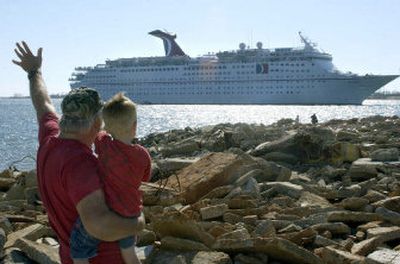
NEW ORLEANS – Some are living on the Ecstasy. Some are on the Sensation. Some are on the Holiday. But most cannot go home.
About 5,000 New Orleanians – including firefighters, police officers and other emergency personnel – are nearing two months of post-Hurricane Katrina life aboard two Carnival Cruise Lines ships docked on the Mississippi River. In the port of Pascagoula, Miss., about 1,800 displaced Mississippians and a small number of federal workers are living aboard a third Carnival-owned ship, the Holiday.
The vessels were leased for $236 million in a six-month deal brokered by the Federal Emergency Management Agency in September.
For many aboard here, even as they compliment the staff for their politeness and small touches such as delivering ice to staterooms every evening, the charms of shipboard life have worn off.
“I took a cruise to Alaska once and that was great, but of course, this isn’t a cruise to Alaska,” said Jim Bialas, 64, whose New Orleans home was heavily damaged in the flood, which destroyed his furniture reupholstery business in nearby St. Bernard Parish.
Nevertheless, he added, the Sensation had been a “godsend” for him and his wife, Donna, 60, a third-grade teacher at the Resurrection of Our Lord school. After they rode out the first weeks after the storm with friends and relatives in Atlanta; Meridian, Miss.; and Slidell, La., he said, the small stateroom on the ship allowed them to at least come back to New Orleans to contemplate how to rebuild their lives.
Jim Bialas was carrying an armload of clothes at the dock here, making his way past a security guard to board the Sensation. He and Donna were able to settle in on the boat because their son, Jon, who is also living on board, is a city firefighter.
There are three square meals a day – plenty of food, buffet-style, but “no fancy desserts and no chilled shrimp,” as a FEMA spokesman, James McIntyre, put it. The bars are closed. No alcohol is served, nor is it permitted aboard, not officially, anyway.
The satellite television works, and there is an occasional movie, such as “As Good as It Gets,” “Seabiscuit” and “The Aviator.” Perhaps a bit oddly, the theme song from “Titanic” occasionally wafts softly over the Muzak system. The gym is open along with one of the pools.
But there are none of the other entertainments usually found on a cruise, such as casinos and live music.
The ships normally take tourists on jaunts to the Caribbean and Mexico, but Carnival agreed to send the vessels to New Orleans just after Katrina hit in late August and signed a deal with the federal government to provide emergency housing.
The government is expected to pay about $192 million over six months for about 2,050 rooms aboard the ships, including meals, plus reimbursement for up to $44 million in expenses for fuel, waste removal, piloting and other expenses. The Department of Homeland Security, which oversees FEMA, said this was less than what the government would pay for hotel rooms or other accommodations for workers and their families in housing-scarce New Orleans.
FEMA has said the cost of housing an individual aboard a ship is about $168 a day. In a statement, the agency said that rooms in hotels that are open in New Orleans “average more than $190 per day,” without meals.
Critics of the arrangement say there are cheaper options. Rep. Henry A. Waxman, D-Calif., says it appears to be “lucrative for Carnival but exceptionally expensive for the taxpayer.”
Bob Dickinson, the president and chief executive of Carnival, said the Miami company was not making excessive profits in the deal.
On Oct. 28, the Senate unanimously passed a measure to require an investigation into the arrangement.