
‘Monsters’ built house
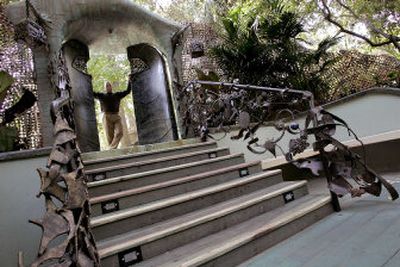
LOS ANGELES – Thom and Leslie Beers are possessed, although in no way like Linda Blair or Emily Rose. The couple does not talk in tongues or levitate, but their Sherman Oaks home in the San Fernando Valley northwest of downtown Los Angeles speaks in an elevated vernacular of its own. An ode to Craftsman and Age of Aquarius arts and crafts, man, the imaginative residence appears to owe its design more to Dr. Frankenstein than Martha Stewart.
And appropriately so, for the Beerses are the husband-wife team behind the Discovery Channel’s “Monster Garage” and “Monster House” series that Thom, 53, calls “more takeover than makeover.” Mechanics might turn a Mustang into a lawn mower on “Garage”; construction crews drop the front 30-foot section of a salvaged 747 into a suburban home on “House” and make it look like part of the decor, complete with a gaming console in the cockpit.
On a smaller scale, the Beerses have transformed a humble mid-century ranch house into a highly personal folk art piece – part Winchester Mystery House, part Pee-wee’s Playhouse.
At the former, rifle manufacturer heiress Sarah Winchester tried to appease evil spirits haunting her San Jose house by constantly expanding and changing the 160-room Victorian mansion for nearly four decades. Thom has been at it only four years, although he cautions, “This is only phase one. I always remember what Anthony Quinn said when asked why he kept building additions: If he stopped doing it he’d die. I am literally addicted to the concept.”
The Pee-wee connection is evident in a riot of color. “I’m into the rainbow,” says Leslie, a music publisher for Thom’s Original Productions company and a jewelry designer. “Every shade has a personality.” When it comes to furniture, she favors shapes with personality, including her tutti-frutti upholstered 1950s amoeba-shaped couches by Harry Segal.
Perhaps it should come as no surprise that the inspiration for the “Monster” family’s home comes from a most benevolent spirit: Sami Johns, Thom’s late mother. Pictures of the Mrs. Senior Citizen USA and nightclub performer in Sarasota, Fla., are all over the house. Leslie keeps one above the kitchen sink that shows Johns in her coffin, its lid festooned with jewels and sequins that her son and daughter-in-law decorated themselves.
It was Johns who taught Thom that the unhappiest people in the world were the ones with limited imagination.
“I’ll never forget she wanted to go to Hawaii and we had no money,” recalls Thom, now executive producer of the “Monster” shows. “She had four kids and a little $12,000 crackerjack box house in upstate New York. And one day we came home from school and she had hand-painted an entire island scene with these massive palm trees in the living room. The next year it was an African landscape.”
When Johns remarried, her wealthy husband indulged her avant-garde tastes, purchasing the 1970s four-panel mahogany carving by Chilean artist Paul Davis that now stands in the Beers’ front garden and the sculpted wooden Hand chair, a fixture in their media room designed by Mexico’s foremost Modernist, Pedro Friedeberg. And what about that Egyptian sarcophagus in the living room?
“That was a prop in the film `Cleopatra,”’ says Thom. “There’s a pickup truck driving down the street with that in the back, and my mom flagged the guy down and gave him a $5,000 check.”
The Beers’ monster house began modestly. Four years ago, Thom came across the typical ‘60s two-bedroom. Built on a five-sided lot with a guest cottage and a natural stream running through the property, it was, he recalls, “a total disaster, a `War of the Roses’ house. There was a bitter divorce between the couple that owned it and they were using the house as a weapon. Everything that could go wrong with a house had, and they just left it that way.”
The Beerses bought the 2,200-square-foot house for $750,000 and have since put at least that much into its transformation for their family, which includes son Max, 8, and a rescue mutt, Rusty.
Rather than redo the interior, Leslie used a rainbow of paint – apple green in the kitchen, silver in a hallway, lipstick red over grass cloth wallpaper in a bathroom with green glass tile floors – and a jumble of retro furniture and art pieces by Keith Haring and Peter Max.
Bead board, wood trim, copper lighting fixtures and two shades of green imbued the bland exterior with personality. “Most clients want a vanilla shell, something safe,” says Carlos R. Alonso, the Beers’ architect, who primarily designs commercial properties. “We went for neo Japanese Craftsman.”
Alonso’s main challenge was to connect the guest cottage to the main house under one roof. Using a chevron shape, he joined the disparate single-story structures with a two-story “crow’s nest” room with a handsome spiral staircase made of solid maple.
It is through this room that the couple’s koi pond flows, visible through a window built into the wood-plank floor.
“What I like about this house is that it has many different environments,” Thom says, adding that the family will take a yearlong break from construction before starting work on a second floor. “Not to be a cosmic cynic, but all is not perfect in the world. There’s always something off-kilter, and the house reminds me of that.”
He recalls a recent morning when he was sipping coffee, walking along a winding boardwalk that reminded him of summers he and his wife spent on Fire Island in New York. He was staring in wonder at a blue heron. “Then I noticed it had one of my koi in its mouth,” Beers says. “It was this incredible moment of tranquility and wonder, shattered by death!”
Artistic partner Karl Johnson understanding of the artistic process allowed for the Entity, a serpentine-orange tile sculpture that shares the pond with Thom’s prized koi. Its tentacles seemingly crash through a window into the house and also travel under the home through a waterway, visible through a glass panel in the floor. Then the Entity re-emerges outside, traveling across the poolside terrace and climbing the exterior wall of Leslie’s art studio.
In a wondrous display of theatricality, it appears as though the Entity has torn a light fixture from the side of the house and dragged it under the water. Naturally, the lamp is still wired, providing a night light.