
Veterans battle a deadly enemy
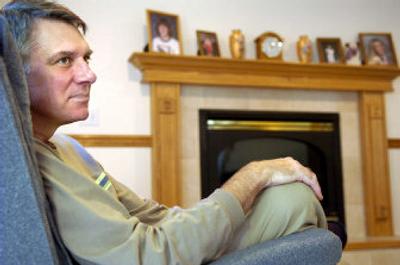
During his 27 years in the U.S. Air Force, Dan Bourson hardly touched down.
Hawaii. Alaska. Japan. Texas. The retired lieutenant colonel was stationed in at least 10 different places.
But these days, Bourson can’t get his feet off the ground. Literally.
The Colbert resident has amyotrophic lateral sclerosis, commonly known as ALS or Lou Gehrig’s disease. The deadly condition, which affects the muscles and eventually the ability to breathe, is more likely to afflict veterans than the general population.
The disease began attacking Bourson’s arms, neck, shoulders and back two years ago, and is starting to weaken his diaphragm now.
It’s also crippling the former basketball player’s jump shot.
In his living room last week, Bourson did “jumping” jacks with his 14-year-old son, Andrew. Bourson’s knees and waist bent awkwardly, but his feet stayed glued to the floor.
“I wish I didn’t have (ALS) but since I do, I guess it helps me focus on what’s important,” he said.
Veterans are about one and a half times more likely to develop ALS than the general population, according to Dr. Yadollah Harati, a Houston-based neurologist who conducted some of the early research on the issue.
And veterans who served in the Gulf War in the early 1990s are twice as likely to develop ALS compared with members of the military who did not, according to a study by the U.S. Department of Veterans Affairs published in the journal “Neurology” in September 2003.
Although the research prompted the U.S. Department of Veterans Affairs to include ALS on its list of service-connected disabilities, opening the door for government-funded treatment, one important question lingers: Why is the disease hitting the military at greater rates?
The cause of ALS isn’t known, but theories abound as to why veterans are at greater risk. Does military stress cause it? Or maybe nerve gases used in the Gulf War?
“Everything is pure speculation,” said Harati, a professor of neurology at Baylor College of Medicine.
Cheney resident Theresa Drewel suspects that her husband, Brian, developed ALS one of two ways. As a survival, evasion, resistance and escape specialist for the Air Force, Brian spent a lot of time outdoors exposed to the insect repellent DEET. He also became very ill when the military vaccinated him against anthrax.
Brian’s first symptoms appeared in 2001. His voice became garbled, and he couldn’t hold his breath under water.
“In retrospect it’s so obvious (he had ALS), but at the time I thought he had a stroke,” Theresa said.
Over two years, Brian lost his ability to talk, so he typed. When his fingers no longer worked he used a computer mouse to communicate with his wife and two sons. And then a laser beam he directed with his head was his voice
And then only his eyes spoke.
Brian died in April 2003.
Bourson also has suspicions about how ALS found him. Like Brewel, he did not serve in the Gulf War.
He was an avid exerciser – not uncommon among the military – often “draining” himself in extreme heat by swimming one mile and then running four. Bourson also had a great uncle with ALS. The disease isn’t often passed genetically, a fact Bourson hopes holds true for his family.
Harati said he rarely meets veterans with resentment about developing the disease.
“The anger is mostly among the caregivers,” he said.
But neither Bourson nor Theresa Drewel begrudge the government.
“You don’t try to point fingers,” Bourson said. “You just deal with it.”
Bourson praised the Spokane VA Medical Center’s care. He commended the federal VA for including ALS on the list of service-connected disabilities and for pursuing a national database of veterans with ALS, an effort that’s under way now. The database will help researchers find patterns among patients and will help the VA inform them about research studies.
ALS is a difficult disease to study since patients typically only live two to five years after they’re diagnosed, Harati said.
Like a stubborn soldier, Brian Drewel fought ALS’s onslaught. Once the disease progressed, Theresa begged him to use a wheelchair, a step he’d been unwilling to take. After he fell and hit his head while holding coffee, Brian changed his mind – to a degree.
“Then he would put his coffee on the wheelchair and push it around,” she said.
Bourson, who had served as an interrogator for much of his career, had a scare early this month while visiting his daughter, Erica, at Washington State University. A 10-yard walk between the football stadium and his parking space caused him to gasp for air. It was “the first time I was fairly frightened I would need some help,” Bourson said.
Although the connection between military service and ALS hasn’t been explained, Bourson hopes research won’t just help those in uniform.
“Once they find out (the cause) not only will it help veterans, but it will help all ALS patients,” he said.