
Hope in their laps
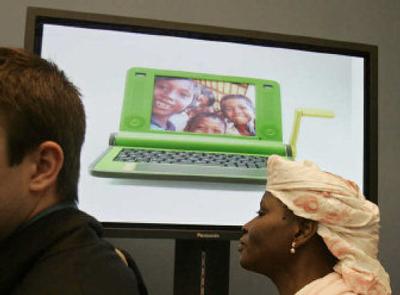
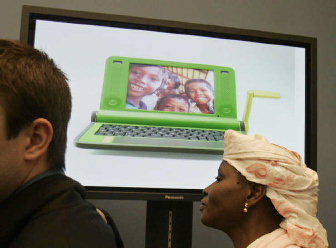
A novel plan to develop a $100 laptop computer for distribution to millions of schoolchildren in developing countries has caught the interest of governments and the attention of computer-industry heavyweights.
First announced in January by Nicholas Negroponte, the founding chairman of the Massachusetts Institute of Technology’s Media Lab, the initiative appears to be gaining steam. Negroponte demonstrated a working prototype of the device last week at a U.N. technology conference in Tunisia.
Negroponte and other backers say they have held discussions with at least two dozen countries about purchasing the laptops. In addition, Massachusetts Gov. Mitt Romney recently proposed spending $54 million to buy one of the laptops for every student in middle school and high school in his state.
Although no contracts with governments have been signed, Negroponte says current plans call for producing five to ten million units beginning in late 2006 or early 2007, with tens of millions more a year later. Five companies — Google Inc., Advanced Micro Devices Inc., Red Hat Inc., News Corp. and Brightstar Corp. — have each provided $2 million to fund a nonprofit organization called One Laptop Per Child that was set up to oversee the project. Negroponte says five companies are bidding to make the laptop, although he declined to name them.
Negroponte remains eager to place the laptop in the hands of 100 to 150 million students. He says he has learned in educational projects in Cambodia and other developing countries that computers spur children to learn and explore outside the boundaries of a classroom, and share their discoveries with their families.
Still, the project would require governments in the developing world to come up with $15 billion to supply 150 million laptops, and it isn’t yet clear how many countries can afford even a $100 machine. Technical hurdles also remain.
The device shown in Tunisia is still an early version; Negroponte says the screen alone will require another three months of development. The designers also have yet to bring the overall price down to $100, although they say they are getting close.
Major computer industry players appear to be taking the venture seriously, including companies like Microsoft Corp. that aren’t yet participating. Microsoft could be confronting a laptop that could become a standard in the developing world — one that, for now, would come without its dominant Windows software.
Negroponte discussed the project recently with Microsoft Chairman Bill Gates and Craig Mundie, chief technical officer of advanced strategies and policy. “We’re in serious discussions to determine what the appropriate type of involvement is with us with their project,” says Mundie.
Steve Jobs, Apple Computer Inc.’s chief executive, offered to provide free copies of the company’s operating system, OS X, for the machine, according to Seymour Papert, a professor emeritus at MIT who is one of the initiative’s founders. “We declined because it’s not open source,” says Papert, noting the designers want an operating system that can be tinkered with. An Apple spokesman declined to comment.
Under present plans, the first production version of the laptop will be powered by an AMD microprocessor and use an open-source Linux-based operating system supplied by Red Hat. Open-source software is not patent protected and can be copied for free. To get the price down, an eight-inch diagonal screen — smaller than standard notebook computers — will run in two modes, with a high-resolution monochrome mode for word processing and a lower-resolution color mode for Internet surfing. It will be powered by both a power adapter, if electricity is available, or through a wind-up mechanism.