
Mardi Gras plans continue
NEW ORLEANS – In the days after Hurricane Katrina hit, Blaine Kern – “Mr. Mardi Gras” in this city – hardly felt like partying.
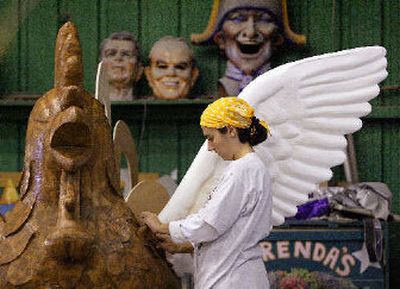
Storm winds hammered his 75,000-square-foot warehouse complex on the west bank of the Mississippi River, where his artists build most of the carnival floats each year. Some of Kern’s favorite giant figures were damaged. “Dracula lost his clothes. The Mummy lost his robes,” he says. In his east bank studio, Kern, 79, says he found “6 feet of water and a dead man. We still don’t know who he was.”
But Kern, whose family has lived in the Algiers neighborhood for generations, says he quickly began to focus on the importance of the 2006 Mardi Gras as the 150th anniversary of the pre-Lent bacchanal – going forward, at least in some form.
“We’ve got to have this party,” Kern says, even as he points to the National Guard troops still handing out food and water from his parking lot. “We’ve got to show the world that we’re down but not out.”
Local officials from Mayor Ray Nagin on down agree. Plans are moving forward for a shortened Mardi Gras season that would include six days of parades rather than 11, culminating on Fat Tuesday on Feb. 28.
Nagin will meet with his carnival advisory committee today to decide on the Mardi Gras schedule. The last carnival to be canceled was during the Korean War.
The major reason for pushing ahead with Mardi Gras despite the devastation Katrina brought to New Orleans is that it normally is a $1 billion-a-year enterprise – and right now, this battered city has little besides tourism to look to for revenue. “This isn’t about fun, this is about business,” Lt. Gov. Mitch Landrieu says. “We’re in the business of producing cultural events, and that business produces tremendous economic impact and provides jobs.”
City studies have found Mardi Gras produces $900 million in annual spending and nearly $50 million in direct tax benefits.
The emotional lift of a successful Mardi Gras could be just as important for the demoralized city. “Being at Mardi Gras 2006 will be like being in Times Square on the first New Year’s Eve after Sept. 11,” Mardi Gras historian Arthur Hardy says. “We need to do this for ourselves even if no tourists come. It’s good for the soul of the city. It’s almost like a jazz funeral.”
The spirit of the city seems willing – 31 of the 34 marching groups, called krewes, that paraded this year in Orleans Parish say they are ready to go for 2006.
Landrieu says 22,000 hotel rooms should be available by Jan. 1, and most of the city’s restaurants will have reopened, although many may have shortened hours because of a lack of staff and a smaller pool of customers.
There are concerns about whether post-Katrina New Orleans is ready for Mardi Gras, including questions about whether the decimated police department can handle even a shortened carnival season.
Acting Police Superintendent Warren Riley told the City Council last week that because the city has no money for police overtime, each day’s Mardi Gras parades must total no more than eight hours.
That will mean shortened parades for some krewes, or even combining some parades. In the past, individual parades by some of the larger groups have lasted longer than eight hours.
“We shouldn’t do more than we can do,” Landrieu says. “I would caution against a long Mardi Gras.”
The city’s budget problems have also revived arguments that corporate sponsors should be accepted for Mardi Gras as a way of underwriting expenses.
Mardi Gras traditionalists are adamantly opposed to the idea, fearing it would commercialize an event that has always been intensely local. Krewes pay for their own floats and parades. “Everyone says no,” says Bill Grace, a lawyer and chairman of the mayor’s Mardi Gras committee.
Kern says krewe leaders would be more likely to accept a suggestion by City Council President Oliver Thomas that other cities send police and emergency medical personnel to help with the carnival in exchange for free rooms and food from local restaurants. That would provide financial aid without corporate sponsorship.
There are New Orleanians who question whether the city should be spending time and money on Mardi Gras when tens of thousands of its residents remain homeless and entire neighborhoods in east New Orleans stand in ruins.
Charles Hamilton, president of the Zulu krewe – a largely African-American marching organization that has more members in storm-decimated eastern New Orleans than any other krewe – says his 500 members are split about whether to have this year’s Mardi Gras.
“There are elements of our organization who say they don’t want to do anything, that we should be focusing on other things,” Hamilton says. Zulu has been marching since 1909.
“But I feel that carnival is one of the good economic benefits to our city. It’s not just about fun - it’s tradition, something that makes our city what it is,” Hamilton says. “If we lose Mardi Gras, we pretty much have given up.”