
Hard knocks teach lessons to hard worker
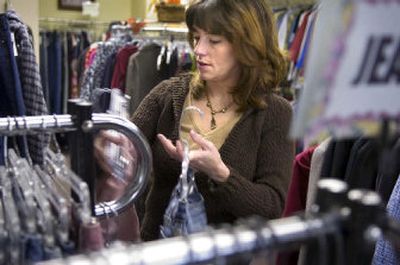

Five years ago, when I did a series of writing workshops at St. Margaret’s Shelter for homeless women and children, resident Rebecca Schiering stood out. She radiated smarts, both the book and street kind.
She weighed 90 pounds but lugged her 1-year-old twin boys everywhere on the bus. A Spokane Transit Authority driver once used her – “the mom with babies in a double stroller” – as the example of how to get on the bus in a speedy manner. Rebecca was headed places.
She’s arrived. In May, Rebecca will buy The Reclothery, a business she now manages. The Reclothery is an upscale women’s consignment boutique on Spokane’s South Hill. Rebecca is 31 now. Her twins are 5, and an older son is 12. The busiest shopping weekend of the year seemed the perfect time to tell Rebecca’s success story.
I met up with Rebecca on Wednesday at The Reclothery, on Washington Street and Sixth Avenue. Rebecca stood behind the counter under a sign that read: “Where Second Hand is First Class.”
The sign’s irony is not lost on Rebecca. The gently used designer clothes sold in the boutique have a second chance at being worn like new. Rebecca is experiencing a second chance at a “normal” life.
She and her two younger brothers grew up in a solidly middle-class family in New Mexico. Her parents, however, divorced when Rebecca was in high school, and she relocated to Spokane with her mom.
“You move a kid in high school and, well, I didn’t adjust very well,” she said.
She dropped out of school, got pregnant, got married, had a baby boy, left her husband, worked two jobs, and then was diagnosed with Crohn’s disease, a painful bowel disorder. Street drugs killed the pain, and the drugs led to bad choices, including a relationship with a man who was in prison when I met Rebecca five years ago.
He was the father of her twins. Yet that pregnancy allowed Rebecca to finally perceive the depth of the hole she had dug herself into. She said, “This has got to stop.”
It did, and fairly quickly, after Rebecca discovered programs that help women in crisis in Spokane – Isabella House, Ogden Hall, St. Margaret’s, Transitional Living Center. She heard about a job opening at The Reclothery, applied, got the job and loved it. She was named manager more than a year ago. In a recent newsletter, owner Bonnie Crum announced the sale of the store that has been part of her life since 1979.
Bonnie wrote of her protégé: “The transition should not even cause a blip on the radar since she knows as much about the store as I do.” She knows far more about our darn computer than I will ever know! Rebecca is a very bright, energetic young woman.”
Halfway through our interview Wednesday, Rebecca and I drove a few blocks to St. Margaret’s to visit with Nadine Van Stone, director of the shelter. On the way, Rebecca told me about her committed relationship with a wonderful man, a mechanical engineer who is kind to her twins. She told me she asked forgiveness of those she hurt in the past, including the son she bore with her then-husband when she was just 18. Her son moved in with his father when Rebecca’s life hit the rough. The 12-year-old boy still lives with his father, though Rebecca sees him often.
We interrupted a staff meeting at St. Margaret’s, but everyone was delighted to see Rebecca. She now donates the store’s unsold clothing to the shelter.
Nadine tries not to predict which of the shelter’s homeless women will make it out, but she sensed from the beginning that Rebecca would be fine. “If you have intelligence, the world can get bigger for you,” Nadine said.
As we drove away from St. Margaret’s, Rebecca shouted, “Hallelujah, I’m alive!”
A few minutes later, we pulled up in front of the store Rebecca will soon call her own, its warm lights welcoming her back to where she finally belongs.