
Virtually unbeatable
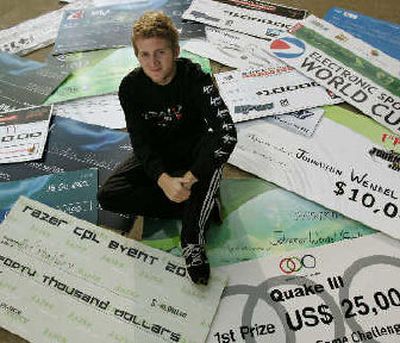
KANSAS CITY, Mo. — Johnathan Wendel’s blue eyes stare raptly at the computer screen, his long, thin fingers gliding the mouse side to side as he moves through dark corridors of a video game where a lethal opponent lurks. Before long, seemingly without effort, he has annihilated his foe.
Time to punch out. Another hard day at work.
Welcome to the basement lair of the 24-year-old Wendel, the man known and feared by aficionados of multiplayer games across the globe as “Fatal1ty.”
If you deign to think of video games as simply a childish pastime, consider this professional game player. He collects a six-figure salary, has his own brand of gaming merchandise and travels the world to compete — regarded by those in the know as one of the most gifted players of his kind.
Last week, Wendel won a $150,000 prize by besting a rival in the Cyberathlete Professional League World Tour Grand Finals. He beat Sander Kaasjager, a player from the Netherlands known as “fnatic.Vo0,” for the competition’s top prize.
“To win $150,000 playing a video game — that’s the best,” he told AP Television News after his win.
If professional video gamers have a knight-errant, Fatal1ty is he.
As gaming leagues have developed and small fortunes are made in what has become a multibillion-dollar business, this lanky blond has become the face of what fans refuse to classify as anything other than a sport.
“I’m doing something no one else has ever done before,” Wendel said in advance of the Cyberathlete competition. “I’m kind of a pioneer.”
In social status terms, some may consider video gaming to be in a class with professional poker or competitive eating.
But Wendel is among those who hope to see it become as American as, well, baseball.
That idea horrifies some, as Angel Munoz found when he launched the Cyberathlete Professional League — the first organization of its kind — eight years ago.
Munoz quit investment banking to follow his dream. He thought the league a great idea but couldn’t seem to even persuade his wife.
“She said, ‘This is why you quit investment banking? To do this crazy thing?”’ he recalled. “I couldn’t convince even the gamers.”
Wendel’s journey began around the age of five, when his father gave him a Nintendo system and he first played Ikari Warriors. He was hooked.
For a decade, when Wendel wasn’t playing one of the many sports he pursued, he was gaming. He wondered if he could make a life out of it.
Around the age of 15, he started taking home prizes from local competitions. At 18, he entered his first professional tournament in Dallas.
He came in third, earned a $4,000 check and decided to make gaming a full-time endeavor, going on to garner titles in competitions in the shooting games Alien vs. Predator 2, Quake 3, Unreal Tournament 2004 and Doom 3.
Wendel, who is for now at least forgoing college, has become the leader in titles and prize money.
And he has licensed his Fatal1ty name — inspired by the word that flashes on the screen with a kill in the game Mortal Kombat, one of his early favorites — to companies for which he helps develop products geared at gamers, from mouse pads to motherboards.
He says he made about $110,000 in 2000, his first pro year, and has been consistently earning a respectable salary built on play he considers work. This year, Wendel expects to make about $200,000 between winnings and products.
Wendel — whose mother and stepfather work on the Ford assembly line and whose retired father has done factory work and ran a pool hall — says he’s fueled by competitiveness.
“I’m very competitive — everything’s about sports and competitions,” he said. “I don’t care if it’s racing for a controller on the bed, I’ll beat you.”