
E. coli in District 3 water
A water contamination emergency on Spokane’s far North Side came at a bad time for a Francis Avenue bar preparing for its biggest weekend of the year as Oktoberfest gets under way at the Screaming Yak.
“It’s probably the worst possible weekend it could have happened,” said manager Bill Koder, who was busy Friday morning preparing for 500 customers each night, Friday through Sunday.
Of course, from Spokane County Water District 3’s perspective, there is never a good time to notify about 4,000 residents that they must boil their tap water after E. coli bacteria was discovered in the water supply. Homes and businesses in the area served by the district were told Thursday afternoon to bring water at a roiling boil for three to five minutes before using it for drinking, cooking, washing or making ice.
The “boil water” advisory remained in effect Friday and won’t be lifted until further notice, said Dan Sander of the Washington Department of Health.
The advisory covers an area north of Francis Avenue, south of Country Homes Boulevard, east of Cedar Road and west of Division.
“We’re working directly with Water District 3 to find the source of the contamination and fix the problem,” said Denise Clifford, director of the Health Department’s drinking water program. Although no one knows for certain what caused the contamination, experts believe it was accidental, possibly the result of backflow from sprinkler systems being blown dry for the winter.
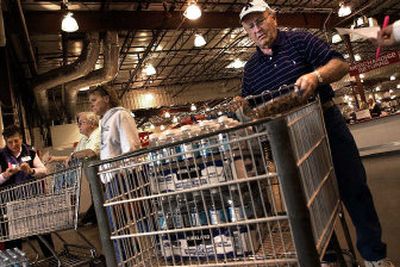
Meanwhile, residents flocked to area grocery stores where bottled water was flying off the shelves on Friday.
It is unlikely that any store sold more than the North Division Costco, where two 40-foot tractor-trailer rigs of bottled water were due to arrive Friday afternoon. Customers wheeled cases of the stuff out the doors in droves.
“We just got back from vacation today and heard about the boil order,” said Costco customer Carol Amann, who was shopping with her husband, Joe, before discovering the order was for Water District 3, not Voting District 3, and the boil order did not apply to them.
When it comes to drinking water you can’t be too careful.
That was the attitude of Costco general manager Fred Schoenhard, who said his company has a procedure in place for just such an emergency. As soon as the big-box retailer was notified of the boil order at 5 p.m. Thursday, the store’s water was shut off, its food court was shut down and its bathrooms were tagged out of bounds.
Beyond that, all of the store’s ready-to-eat products were destroyed as a precaution, Schoenhard said.
Despite the cost, he said, “It’s the right thing to do. We’re always willing to err on the side of caution.”
Most strains of the bacterium Escherichia coli are harmless and live in the intestines of humans and animals. The strain detected in District 3’s water supply was not E. coli 0157:H7, the type that produces a toxin that can cause serious intestinal distress, kidney failure and death.
“It’s not your hamburger-type E. coli,” the Health Department’s Sander said. But the strain detected in the north Spokane neighborhood can cause flu-like symptoms and diarrhea, he said.
Mead School District officials made the decision Thursday night to shut down Evergreen Elementary School, said Cal Johnson, executive director of student services and activities. It wasn’t until about 9:30 a.m. Friday that they confirmed their water supply was not contaminated.
“If we were going to err, we were going to err on the side of safety for kids,” said Johnson, who added that the district did not want to risk exposing the entire school to children coming in from contaminated areas, which could make any exposure problem worse.
Most parents seemed to get the message. Parents called throughout the morning to see if other schools beside Evergreen were running as planned. Officials expect Evergreen to be open again Monday.
Spokane Public Schools determined Friday morning that none of its schools was tied to the contaminated water district.
“We took this seriously,” said Joe Madsen, director of safety for the Spokane district. “We were at the point to where we would have canceled school.”
At the Screaming Yak, one of 23 restaurants and bars in the area, Koder’s staff was taking no chances, either.
At considerable cost, the manager called in extra employees who were stocking refrigerators with bottled water and drink mixers. Because of the emergency, the bar was unable to use its mixer gun, which enables bartenders to make drinks faster and cheaper than having to use canned beverages. Antibacterial liquid replaced soap in the bathrooms.
Koder was planning on the boil order lasting until Monday.
“They said they’d call us back when we can use our water again,” he said.
Spokane Health District spokeswoman Julie Graham said businesses like bars and restaurants could stay open as long as employees took adequate precautions, such as not using tap water to wash hands or produce and making sure dishwashing machines ran at temperatures high enough to kill the bacteria.
On Thursday, emergency chlorine treatment was applied to two reservoirs and lines serving the affected area, said Ty Wick, manager of Water District 3. The district hasn’t had a contamination problem since 1986, when a bird got trapped in another part of the district’s system in Mead, Wick said.
It will be Sunday at the earliest before the boil water order can be lifted, Wick said. Water samples were taken Friday and will be taken again today. The samples take 18 hours each to process.
“If the results come out OK, we’ll be able to lift the boil order on Sunday,” Wick said. The water district will use the media to notify the public, he said.
The E.coli contamination problem could have been caused by backflow contamination from people blowing out their sprinkler systems for the winter, Sander and Wick said.
“That’s one possibility. But we may never know where it came from,” Wick said.