
Fill ‘er up: Gas prices load buses

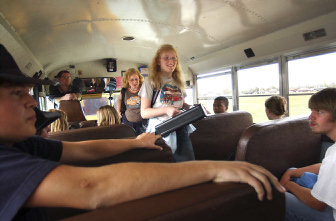
One Central Valley school bus was mostly empty Friday morning as it rumbled toward Central Valley High School along Sprague Avenue.
It was puzzling to driver Mike Carey, whose No. 1 bus is nearly full most days: “I’m hearing it’s because of the fuel prices,” he said.
Empty buses are rare this year for Inland Northwest school districts.
The Mead School District north of Spokane has more crowded buses. School bus drivers in Cheney and Coeur d’Alene have also noticed a marked increase. Some of that can be attributed to growth in certain areas, but drivers agreed that gas prices are also driving ridership.
“We’ve had to add some routes that traditionally have had enough students for one bus,” said Jack Lewis, the director of transportation for Mead schools. “I think people are realizing that it’s much more cost-efficient to haul 50 or 60 (students) on a bus than four or five in a car.”
Carey hopes his bus has more passengers Monday, when Ridership Week begins for several Spokane-area school districts, including Central Valley.
Once a year for a week all bus drivers in the state are required to count students boarding school buses during the morning commute.
Washington state puts those numbers into a formula to determine the mode, or the most common, number of riders for the week. That figure is used to calculate the amount of state funding districts receive toward transportation costs.
“We don’t get dollars for the buses that we have. We get them for the number of kids we’ve got,” Carey said.
Those dollars are especially needed this year, as the cost of fuel reaches near-record highs.
“We’re paying over a dollar more a gallon this year over last year,” said Carol Brown, director of transportation for Coeur d’Alene schools. “If this continues, it’s going to be a problem for everybody.”
While the boost in ridership will help cushion expenses, it only covers about 50 percent of the total costs for transportation, said Jeff Hanley, CV transportation supervisor.
“It does balance things out, and sometimes you do come out ahead,” Hanley said. “But it will never pay for the transportation program in full. There’s too much stuff that is non-funded, like sports trips.”
Costs associated with extracurricular activities come out of the district’s general fund, Hanley said. Central Valley has budgeted about $3.1 million for transportation this year.
The district runs biodiesel fuel in its buses, which is made in part from vegetable oil or animal fats. It burns cleaner but is slightly more expensive. The fuel is subsidized by Spokane County Air Pollution Control, but in the end the district ends up paying what everyone else pays, Hanley said.
In Idaho, districts are required to calculate ridership in the fall, winter and spring. They also figure the average number of riders based on both morning and evening counts.
“They do it three different times to try and make it more fair, because there are not as many kids riding during certain times of the year,” Brown said.
The number of riders can vary greatly even throughout the week. While elementary and middle school students tend to be consistent riders, students are less likely to stand in the rain waiting for the bus and are more likely to ride during snowy weather. Students may be more inclined to ride bicycles on sunny days, and high school students are always erratic riders because of their variety of activities.
As Carey pulled his bus up to the curb at CVHS on Friday, he noted several students who usually ride his bus standing in a crowd of cross-country athletes leaving for a trip. He saw two more of his students walking near the school, and another driving his parent’s car.
A white van had also passed his bus on Sprague with one of Carey’s passengers inside.
“Probably slept late,” Carey said. “I’m guessing the parents are probably not happy about spending the gas, when he could be riding the bus.”