
Team carves out canoe worthy of trip
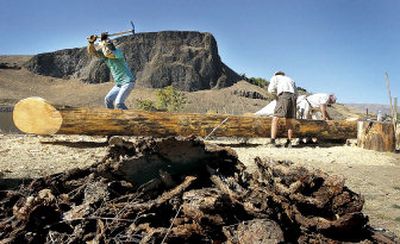
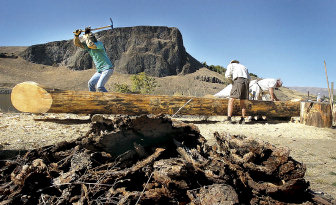
LEWISTON – Chunks and shavings of ponderosa pine litter the ground as its former 7,000-pound girth is molded into a new life as a dugout canoe.
The three men hacking away at it, as they have been since Sept. 24, are turning the giant log into a 500- to 700-pound vessel similar to the one Meriwether Lewis and William Clark used on their expedition 200 years ago.
“It’s on a most serious Jenny Craig diet,” joked Michael Clark as he took a break from the sunup to sundown work.
Once it is finished, it will be launched from Canoe Camp at Orofino on Friday.
The traveling Lewis & Clark Corps of Discovery II exhibit, celebrating the bicentennial of their expedition, begins today next to the Quality Inn in Clarkston.
It goes through Oct. 9, and features speakers, plays and other information about the expedition. Although the canoe isn’t part of the event, it’s one of several things being done while the exhibit travels through this area.
“This is something we’ve been working on for a number of years,” said Doreen Bridgmount, president of the Asotin County Lewis and Clark Bicentennial Committee. “Finally, after all the planning and many, many meetings, it’s finally coming together.”
Building the canoe is a tedious job, although aided by a tool not available to Lewis and Clark: a chain saw.
During a lunch break in the shade, Michael Clark, an educator from St. Louis, contends those builders 200 years ago would have used one, had it been available to them.
He and John Ruskey of Clarksdale, Miss., came specifically for this task, setting up their own canoe camp north of the Lewis and Clark Discovery Center at Hells Gate State Park in Lewiston.
Ruskey owns a canoe building company and guide service, and has been building dugouts since 1999, he said, because “I’ve always loved water and don’t particularly like motors.” Since then he’s done a few, with the first one he did taking him two years.
When he finished building a dugout in 2002, he and Michael Clark took it down the length of the Mississippi River. They’ve gone down several other rivers together since then.
The dugout they’re constructing now will take about two weeks, with six people working on it intermittently.
He said while they’re hoping to get it close to how Lewis and Clark’s canoe would have been, there’s not much in the journals to go on.
Large chunks of wood flying are a hazard, although other than sunglasses, hats and gloves they are unprotected from misguided strokes.
Also helping them is Bob Frazier, part of a three-man group that is in the process of traveling the same route Lewis and Clark did, using canoes and horses.
Frazier, a Revolutionary War re-enactor from Virginia, said he decided to go on the journey that started in 2003 in Washington, D.C., “to get away from the 21st century.”
The two other members show up at the camp midafternoon, dressed like corps members – Scott Mandrell of Alton, Ill., as Lewis, and Churchill Clark from Denver as his ancestor William Clark.
Mandrell jumps right in, hacking away at the bottom of the deepening canoe. He got a grant from the National Park Service to be able to leave his teaching job and go on the journey.
They are documenting it with video, which is streamed at www.ali.apple.com/lewisandclark.
“I found out from an early age I was related (to Clark), and really wanted someone from the family to do this,” Churchill Clark said.