
U.S. space tourist begins trip
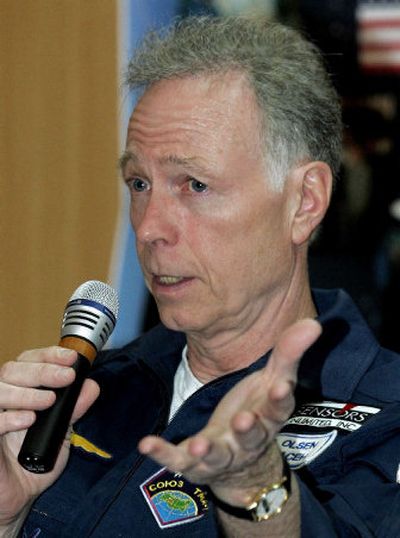

BAIKONUR, Kazakhstan – A Soyuz rocket carrying U.S millionaire scientist Gregory Olsen and a Russian-American crew lifted off today from the Central Asian steppe, launching the world’s third space tourist on a two-day journey to the international space station.
The rocket streaked into the blue sky with an earsplitting blast, trailing blindingly bright yellow and pink flames, as the crew’s family and friends, as well as U.S. and Russian space officials, watched from a viewing platform at the Russian-leased Baikonur Cosmodrome in Kazakhstan.
Some in the crowd of more than 100 people gasped at the blastoff and then again at the explosive separation of the first booster segment – the only audible reaction until the spacecraft entered its initial designated orbit nine minutes after the launch. Then the crowd burst into applause. The crew reported that all was well aboard the craft.
Olsen, the 60-year-old founder of an infrared-camera maker based in Princeton, N.J., reportedly paid $20 million for a seat on the Expedition 12 flight.
His daughter, Krista Dibsie, 31, accompanied by her husband and 4-year-old son, Justin, videotaped the liftoff. Justin held his hands over his ears, his mouth wide open.
As Dibsie craned her head skyward, tears rolled down her cheeks, and she said quietly: “There goes Dad. Love you, Dad.”
“Now I’m nervous for him,” she said. “I wasn’t before but now he’s up there and gosh, he’s out of this world. I can’t believe it.”
Olsen, who holds advanced degrees in physics and materials science, defended his presence in the capsule as a necessary step in the evolution of space travel.
“I would hope that my flight would help, if just to make space flight more routine,” Olsen said in a telephone interview with the Associated Press on the eve of the flight.
In the hours leading up the launch, the trio, outfitted in bulky spacesuits, had tested systems in the capsule. Russian cosmonaut Valery Tokarev and U.S. astronaut William McArthur were riding with him.
The cash-strapped Russian Federal Space Agency has turned to space tourism to generate money. Olsen is the third non-astronaut to visit the station: California businessman Dennis Tito paid about $20 million for a weeklong trip to the space station in 2001, and South African Mark Shuttleworth followed a year later.