
Mazda MX-5 replaces popular Miata
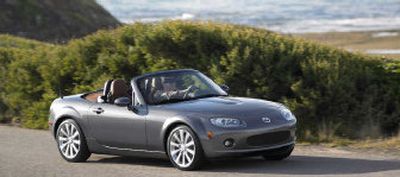
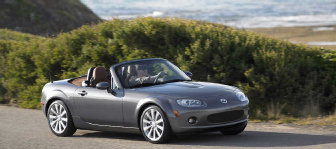
Say goodbye to Miata, ladies and gentlemen, and let’s have a hand for the all-new, 2006 Mazda MX-5.
After 16 years, Mazda is axing a slice of automotive history, sacrificing the romance of a lovely name to obscure demands of the market, whatever they may be.
To be sure, the Miata moniker will remain affixed for a time, as in the “all-new, 2006 MX-5 Miata,” but that’s a sop to traditionalists.
No one seems sure why the fine, old name was jettisoned; for years, Miata defined affordable fun.
“Truthfully,” I’d tell people in my more rational moments; “the Miata is all the sports car anyone needs.”
I’ll say the same of the MX-5, although it won’t fall as trippingly off the tongue.
When introduced in 1989, the Miata was the sole inheritor of the British tradition, a canvas-topped, two-place roadster with the engine up front and the drive wheels out back. Other makers had deemed the subcompact sports car obsolete.
The Miata quickly differentiated itself from its spiritual forbearers; the lights, heater and radio worked without coaxing, the oil stayed inside and the rain stayed outside.
Over the years, the Miata has become the best-selling two-seat sports car ever and spurred a roadster revolution that has its most recent manifestation in the Pontiac Solstice.
Mindful of its sterling heritage, Mazda approached the Miata redesign with care; while the MX-5 shares not a single component with the Miata, no attempt was made to foster a radical, new Miata tradition.
The new car is marginally larger than its predecessor. The wheelbase has grown by 2.6 inches, both length and width are up by 1.6 inches and the MX-5 is a half-inch taller than the Miata.
The sheet metal is of a piece with tradition, looking every inch a new-gen Miata. Its fenders flare more dramatically and its headlights have a purposeful, all-business appearance, but they still flank that cute, happy-face grille.
Clear-lens taillights highlight the clean tail, and a small decklid lip serves as a functional airfoil.
Form follows function on the inside, which is dominated by a quintet of chrome-rimmed gauges. Gadget central is cleanly designed and straightforward, with real knobs to control the audio and heating/air conditioning functions. Cruise control and redundant audio control buttons are located in the steering wheel.
A short-throw shifter resides in the center console, which also contains a locking CD storage bin. As is lamentably true of all small sports cars, storage is at a premium. Good luck if you’re carrying loose sheets of paper on a day too beautiful for top-up driving.
Mazda sticks with a manual top on the MX-5, but has improved it. The top now tucks into a space behind the seats, with its leading edge forming its own rigid tonneau cover, and latches snugly when properly seated.
A pair of fixed roll hoops is located on the rear deck, just aft of the seats, which are well formed, well bolstered and give every indication of being comfortable over the long haul.
Despite only minimal growth, the cockpit is now more accommodating, with more seat travel and elbowroom. Hip points have been moved and room has been carved out for side airbags, with the added benefit of creating more room for human cargo.
Given the opportunity to re-engineer their baby, Mazda designers moved the power train rearward by 5.3 inches. Similarly, they moved the battery and gas tank nearer the center of the car, maintaining a nearly perfect 50/50 balance and better fixing the car’s central point of rotation. The MX-5 is even quicker and more stable through fast transitions than the original car.
Even though it’s larger, the MX-5 has gained only 22 pounds, thanks to liberal use of aluminum as well more innovative measures.
Bending stiffness is up by 22 percent and torsional rigidity by 47 percent.
A 170-horsepower 2-liter four powers all six trim levels, which range from the de-contented, race-oriented Club Spec ($20,995, including destination) to the $27,260 3rd Generation Limited.
It includes variable valve timing and is paired with a five-speed manual, six-speed manual or six-speed automatic. Torque measures 140 foot-pounds, 90 percent of which is available from 2,500 rpm to redline.
The 0-60 romp happens in 7.0 seconds.
If balance is the measure of a great sports car, the MX-5 qualifies. Mazda has resisted the temptation to power it up, correctly believing that it struck the proper balance the first time.
The power train never overwhelms the center-backbone chassis or upper and lower A-arm front suspension and 5-link rear setup.
The power-assisted rack-and-pinion steering system is communicative as it approaches its limits and the 17-inch performance tires (some trims are equipped with 16s) provide a stable patch and behave predictably at the limits of adhesion.
Braking power puts it in the same league as the BMW M3 SMG and the Porsche Boxster.
In short, this is a car that can be thrown around with little fear of unexpected consequences. For those who want more, an optional Sport suspension package includes limited slip rear differential and sport suspension with Bilstein shocks.
In terms of overall ride quality, the MX-5 is better behaved than the Miata, less harsh and more compliant, especially in rugged conditions. More refined and more comfortable, the MX-5 nevertheless is a better performer in virtually every way.
So there it is, Mazda’s long-awaited Miata replacement, although it’s less replacement than evolutionary big step. And, once again, Mazda proves one needn’t mortgage the farm to enjoy the pleasures of true sports motoring.