
Sacajawea role a manifest destiny?
Lewis and Clark probably had no idea of the drama they’d one day inspire.
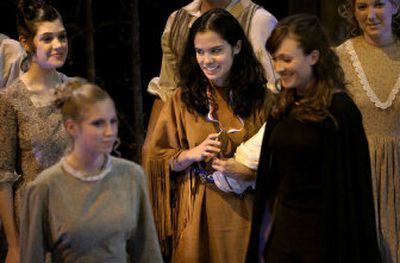
A local musical production at Gonzaga University has propelled a high school girl into a lead role as one of her heroines – Sacajawea.
The moment 16-year-old Julia Keefe walked across the stage as an understudy she got the role permanently.
“When she stepped on stage, she took over and became not the understudy but the model,” said John Hofland, director of GU’s theater program. “She’s got a presence that tops many of the college actors.”
Keefe, a junior at Gonzaga Preparatory School, debuted Friday night in “Lewis and Clark Part One: Manifest Destiny,” a musical production based on the explorers as told through Clark’s slave, York.
Keefe has one of the four primary roles and is the only American Indian on stage. She spent six years of her schooling in Kamiah, Idaho, on the Nez Perce Indian Reservation. Her family moved to Spokane six years ago.
The role brought Keefe face to face with an idol.
“I used to do projects on Sacajawea,” Keefe said.
As a Nez Perce, one of the Indian tribes who met the Lewis and Clark expedition, “this is more of who I am,” Keefe said. “I’m putting more of myself in the character.”
When Gonzaga first called her, Keefe wondered if she’d have time for another activity.
“I thought they wanted me to be Native number five or something,” Keefe said.
She attends classes at Gonzaga Prep from 7 a.m. to 2:30 p.m. Then she does homework until rehearsal for her school’s Shakespearean production, “Much Ado About Nothing,” which goes from 4 to 6 p.m.
“I thought my parents would say, ‘No. You have too much on your plate.’ “
They all saw what an opportunity this could be. So now one of her parents drives her to GU for rehearsals, from 6 to 10 p.m.
Keefe dug in and did more research on her longtime idol. She learned that Sacajawea’s husband, Charbonneau, was documented in the Lewis and Clark journals for striking his Indian wife.
In the play, Sacajawea smacks her fur-trapper husband.
Gonzaga history professor Robert Carriker, a Lewis and Clark scholar, said the play is entertainment with some small liberties. It originally was produced at Creighton University in Omaha, Neb., two years ago.
Hofland said the play was used at the urging of Raymond Reyes, Gonzaga vice president of diversity. Hofland said Reyes pointed out that Spokane sits near several Indian reservations, so why not touch on some Indian history in a play? After some research, this is what they settled on.
GU’s Theatre Arts program worked with Spokane Interplayers director Nike Imoru.
While there are musical numbers, a love story and narration by Clark’s slave, York, the story ends on a note historians have highlighted as a moment of racial and gender equity.
Sacajawea and York were allowed to vote with the white males in the corps on whether the expedition should cross the Columbia River immediately or wait a day.
Like the original journey, there were obstacles – even drama – in staging this production.
Hofland decided to pass over an American Indian GU student for Keefe, which generated some tension. And with all the logistics of getting a fairly large production done, Hofland canceled a previously planned panel discussion about the play’s content.
“It was more than I had energy for,” Hofland said. “I don’t know of any other show where I found myself working so hard.”