
Growing giants takes TLC
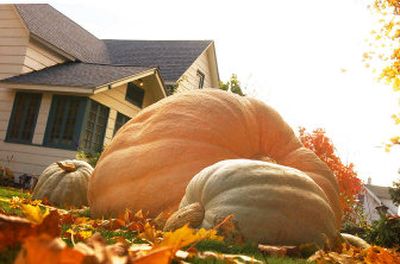

By Adam Blalock’s usual standards, it was one of his smaller giant pumpkins for 2005. But his 658-pound giant pumpkin still took the top prize at this year’s Spokane County Interstate Fair. So did nine of his other entries in the largest vegetable classifications. Not bad for a guy isn’t quite 20.
His two really big ones were taken to a weigh-off earlier this fall in Oregon sponsored by the Pacific Giant Vegetable Growers Association. There, his pumpkin weighed in at 961 pounds and his green squash at 961.5 pounds – enough to win him $1,000 in prize money, but off his personal best of 1,073 pounds.
Growing giant vegetables for competition has been a passion of Blalock’s since he was 14. “I always liked being outside in the dirt and mud when I was little,” he said. His love of dirt took on a new dimension when he discovered the giant vegetable contests at the Interstate Fair. “You’d see these things at the fair and just get curious to see if you can do it too,” he said.
“Seeds are THE most important thing. You aren’t going to get anything special if you don’t have the genetics working for you,” Blalock said. Because the genetics of size matters, most serious pumpkin-growing competitors use strains of the Atlantic Giant pumpkin and trade seeds through club exchanges or over the Internet
Soil preparation is the next critical factor. Giant pumpkins take a lot of nutrients and water when they are growing 20 to 30 pounds a day during their peak growing season. Blalock gets his soils tested regularly. “That lets me know what nutrients and fertilizers to add or shy away from,” he said. He adds manure to his patch all through the year and fertilizes regularly with organic fertilizers.
“Then it’s a matter of putting in the time,” he said. “You need to be out in the garden all the time weeding, spraying and watering.” The seeds have to be started indoors in mid-April and then put out in the garden by mid-May. They have to be protected from frost so they have all the heat they can get to grow in our short season.
Once they start growing, Blalock has to trim and water the plants very carefully so they put all their energy into growing fruit. When they begin flowering, he handpicks the best female flowers and hand pollinates them with the best male flowers he has.
Once the fruits start growing, he selects the best one per plant. He has to shade them to keep the skin from drying out too much and cracking the shell. The Inland Northwest’s hot, dry summers are hard on fast-growing giant vegetables. If the weather is cool, he has to cover them to keep them warm at night.
Finally it’s time to haul the beauties to the weigh-offs. To pick his biggest, Blalock uses a special tape measure that reads both inches and the corresponding poundage that measurement should equal. Since most regional competitions are on the coast, he has to load up his beauties and drive them to the competition. Unfortunately, the tape measure system only gets him an approximate weight and real moment of truth is at the competition. His two fruits weighed much lighter than he expected. “According to the measurements, it should have easily been over the world record of 990 pounds (for green squash),” he said. “It taped out at 1,050. Our weather was so weird here that all my stuff was going kind of light.”
Blalock isn’t keeping his passion for growing giants just as a hobby, though. He’s putting all that experience into a crop management degree at the University of Idaho. To focus on his studies, he plans to take time off from most of his growing next year. “It’s time to be a kid. I’ve got my whole life to do this.”