
Tribes focus on exercise at schools

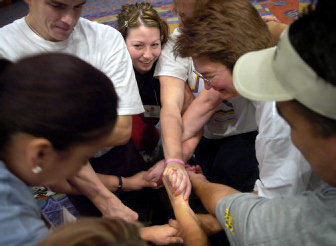
The shrieks and giggles came for hours as they circled each other with games of tag and modified baseball. They all laughed while bouncing colorful balls on a bright parachute. Then they ducked underneath.
It would be easy to mistake this group of adults for a second-grade class of coltish students.
This week a group of adults from Indian reservations in Oregon, Washington and Idaho learned new ways to get their kids active.
“The beautiful thing is kids don’t even know they’re getting a workout,” said Ken McFadden, a trainer for the two-day event hosted this week by the Spokane Tribe at the Kalispel Indian Northern Quest Casino in Airway Heights.
In Indian country, experts have asserted for years that a loss of traditional diets and a lack of exercise have driven diabetes rates higher than any other population. Now the Wellpinit School on the Spokane Indian Reservation 40 miles northwest of Spokane is gearing up to get its students more active. The idea is to use more physical activity during regular school lessons throughout the day.
“I’m a firm believer in movement,” said Tim Ames, superintendent of Wellpinit School. “I believe that kids need to love to come to school, and I don’t think the WASL (Washington Assessment of Student Learning) makes kids love to come to school.”
Having fun and learning through play makes the school day fun and purposeful for both student and teacher, Ames said.
In Spokane County’s largest school district, Spokane Public Schools, grade school students get two 30-minute physical education sessions per week. Teachers are directed to ensure they get another 40 minutes of activity.
Spokane schools combine what they call lifelong health education with the activities. Many districts do similar approaches.
Wellpinit will move to a more active approach this year.
Ames joined Wellpinit from the West Valley School District in July. About that time, Randy Garza – a Shadle Park High School and Eastern Washington University graduate – was hired by the Spokane Indian Tribe as the new health educator.
Garza had worked most recently on the Alamo Navajo Indian Reservation in New Mexico, where they used a program for grade school children called Sports, Play & Active Recreation for Kids, or SPARK.
The goal is to get an extra 30 minutes of physical activity daily to help prevent obesity and diabetes.
Like the Navajo Nation, the Spokane Indian Tribe is trying out the program.
Halfway through Tuesday’s training, a group of Wellpinit teachers talked over lunch about how to get their students more active while getting through lesson plans.
“It’s going to be tough,” said Les Hegney, a fifth-grade teacher.
He thought it might work best as an incentive for students when they do well on a lesson.
Teachers will have the backing of Ames to find a way to make it work. In the last few years, district leaders have drawn attention to their challenge of reforming education systems to meet the federal No Child Left Behind Act.
Ames said the narrow focus on academic improvement has taken something away from education.
“As an educator, if you can strengthen the whole child the academics will come,” Ames said. “Believe me, I understand the WASL and No Child Left Behind. As educators we’re missing the whole child.”
Since Ames started, the school board has met the tribe’s Business Council members and everyone is supporting the district’s focus, Ames said.
An extension of that effort was the Spokane Tribe’s hosting of this health conference, which was organized by Garza and drew about 60 educators. SPARK trainers gave two days of game examples.
One of the attendees, Carolyn Harvey, flew in from the Warm Springs Indian Reservation in Oregon where she works as the wellness coordinator.
Tribal leaders have asked her to focus her health efforts on the children, which is what brought her to the conference.
As a non-Native, hearing about something that works on another Indian reservation is definitely worth checking out, she said.
After a day of play, she said she was ready to bring more people into the game.