
Sisters’ Desert House an oasis of life
POCATELLO, Idaho – The Franciscan Sisters of the Eucharist call it Desert House, but it’s really more of an oasis. It’s situated on a patch of green earth with flower, herb and vegetable gardens in the midst of acres of dry grass and sage.
Cattails line a spring-fed pond, stocked with pan-sized rainbow trout, that attracts trumpeter swans, sandhill cranes, great blue herons and other migrating birds. Sister Mary Paul’s elaborate flower beds add a touch of color to an irrigated bank, accessed by a long, wooden foot bridge.
They have seven goats, five ewes, nine baby lambs and two small dogs, and they don’t disturb the small, mud homes swallows have built on outside walls. They were saddened by the news when a well-meaning visitor killed Helen, one of the snakes that occupied their underground barn.
It’s a serene setting for an order of Catholic nuns who answer their phone with a sincere, “Peace be with you,” and live according to the example of St. Francis of Assisi, known as the patron saint of animals and the environment.
St. Francis, Sister Mona explained, encouraged people to use their hands to cultivate life because he believed all creation can teach people about God.
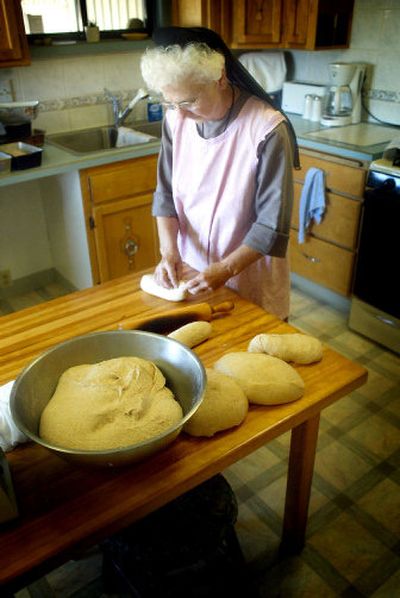
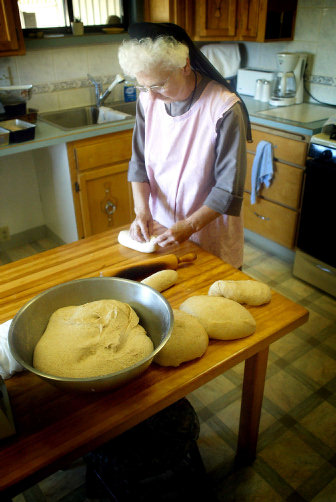
Inside Desert House, the heavenly aroma of fresh-baked whole wheat bread filled the air as 14 loaves cooled on the kitchen counter. Sister Mona paused to a let a massive dough ball rise, and waited for another batch to bake. She planned to bake 75 loaves that day in preparation for a convent fund-raiser, Harvest Dinner, scheduled for noon to 5 p.m. on Sunday.
“She’s been baking for a month at least,” Sister Mary Paul said, adding they sell loaves at various times throughout the year, especially during the Christmas season.
Nine Franciscan sisters live together in the home, located off Interstate 86, Exit 52, on rural property west of the Pocatello Regional Airport.
The property is located right on the historic site of the Oregon Trail. Each June, the sisters take children on a three-day wagon ride along back roads following nearly the same path as the Oregon Trail to Massacre Rocks State Park. During their 52-mile trek, the children are treated to jerky, hard bread, dutch-oven meals and homemade root beer.
The sisters moved into the home, formed from two Army barracks moved to the site and joined, in 1975. It contains a kitchen, living and dining room and four bedrooms. They converted the garage attached to their home into a chapel.
In 1986, they had a new, large garage built, designed with the Harvest Dinner in mind. It has ample room for annual crowds of 300 to 600 at the dinner. They also set up two tents for buffet lines to serve bread, jam and homemade stews, made from their own produce.
A trailer home provided additional housing until 1995, when they had an addition built with eight more bedrooms, a library and a workroom. Sometimes, other groups rent the workroom for meetings, and the sisters cook meals. The following year, they replaced the trailer home with a manufactured home used for retreats and guest housing.
The cloister of the home, which includes bedrooms and the library, is closed to outsiders.
Their chapel was built with the four elements of creation in mind: earth, water, fire and wind.
A large boulder topped with a glass altar reminds the sisters of the earth. The chapel was built around the boulder. Water is represented by an old irrigation pump, which serves as a font for holy water, and an irrigation head – a heavy, iron object that swivels and diverts water into various irrigation pipes – houses the Blessed Sacrament, believed by Catholics to be the body of Christ.
A stained-glass window depicting the burning bush which Moses visited symbolizes fire. Seats in the chapel face several windows overlooking the pond and surrounding trees, allowing the sisters to watch the wind blow.
Most sisters have outside jobs. Both Sister Mona and Sister Mary Paul are licensed counselors, specializing in marriage and family at the Franciscan Counseling Center.
At home, they devote extensive time to chores and prayer.
They raise about half of their own food in their gardens, greenhouse and corral. They take turns cooking, and each has routine tasks to perform.
On winter days, Sister Mary Paul rises at 4:45 a.m. to care for the animals before morning prayer and meditation at 6.
Sister Anthony Marie is in charge of the expansive vegetable garden, which includes rows of tomatoes, squash, corn, peppers, carrots, parsnips, onions, cucumbers and other produce.
Much of the decor that gives the landscaping at Desert House its character is salvaged junk, like the water symbols in the chapel.
Sister Mona has a knack for finding refuse at junkyards and putting it to good use. There are fountains made of old well drill bits, sculptures created from rusty plows, an old saw blade converted into a sign for the chapel and a host of other artistic creations.
The garden is surrounded by a hedge and an iron fence – salvaged metal grids used to build airport runways – with an archway entrance made from a wagon wheel.
The sisters name many of their buildings. Their shed is called the Prodigal Shed.
Their guest house is known as Domus Jubilio, meaning the “Jubilee of the Lord” in Latin. It was named in honor of the 75th anniversary of Sister Chrysologa’s life devoted to Christ.
Chrysologa, now approaching her 101st birthday, still resides in the convent, although she can no longer fish in the pond as she once loved to do.
The sisters call their wooden bridge the Bridge Over Troubled Water because of the moss that fills the pond. Sister Mary Paul plans to introduce a species of fish that eats moss to curb the problem.
The underground barn, where Sister Mary Paul was pleased to spot a new snake coiled on the top of a cool rock wall, is called Clave, meaning cave.
A family built the sisters’ greenhouse as a memorial to their father. Near the greenhouse, there’s a small orchard of fruit trees, all which were planted in remembrance of a particular person.
“It’s a wonderful life,” Sister Mary Paul said of her home since 1988. “For myself, I kind of know this is what I was really called to do. It’s a call to service, and it’s very rewarding.”