
Who makes whom?
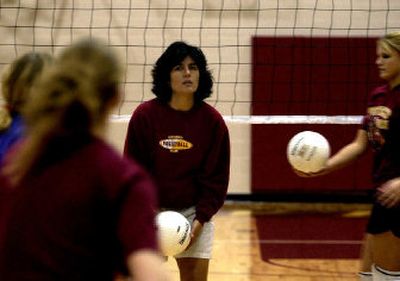
It is volleyball’s equivalent to the age-old question about the chicken and the egg. Does a setter make the hitter, or vice versa?
Opinion varies.
“I think a setter is the key to the whole thing,” Ferris coach Stacey Ward said. “It doesn’t matter how good hitters are if you can’t get them the ball.”
Her belief is backed by Mead head coach Judy Kight, whose Panthers have won the last two State 4A titles.
“A setter is crucial,” she said. “You must have one to run the offense. They are most important in transition.”
John Reid, coach of last year’s regional qualifier Mt. Spokane, had a different take – somewhat.
“From a coach’s perspective I’d rather have a good setter,” he said. “I tell you what, though. At Division I they’re looking for hard-core hitters. It’s a banger that wins games.”
Greater Spokane League teams will find out which comes first this year. Mead has the bangers, but is replacing its setter, though one with program experience.
Gonzaga Prep, third in state last year, returns its setter, but graduated all its power at the net.
Nowhere will volleyball’s chicken-and-egg conundrum be tested more than at defending GSL champ University, where the cast surrounding setter Kara Crisp will be practically new for the first time in her four years running the Titans offense.
“She’ll be the glue to that team,” Kight said. “Kara will hold them together in more ways than just setting.”
This year the Titans are experimenting with a 6-2 (two setter) offense to take more advantage of Crisp’s all-around abilities.
Until Crisp’s freshman year, the Titans had only a brief window of volleyball success, going 29-19 and making the district playoffs three times between 1993 and ‘95. Otherwise it was a second-tier program and won just three league matches during the three seasons prior to her arrival.
Then a convergence of talent led to a glorious run the last three years that included an unprecedented three regional and two state appearances, culminating in last year’s first GSL title and sixth-place state finish.
Crisp, the school’s first freshman varsity player, and three sophomores arrived to bolster a veteran core in 2002.
Coach Amanda Velasquez is emphatic when affirming how important she was to U-Hi’s success following the three-year low point.
“We had girls who could hit the ball, but didn’t have a true setter. I had to force people to do it,” she said. “When we got Kara, it pretty much says it all.”
Now, only Crisp remains from that ground-breaking 2002 group and she’s one of only four returning from last year’s state team. Graduated are the other three-year players, two of them all-league hitters.
“It’s harder because there’s not as much experience and we haven’t played together,” said Crisp, who’s being asked to provide leadership. “It’s been harder just because I had so many close friends (who graduated).”
Crisp, also a member of U-Hi’s state placing basketball team, played a variety of volleyball from YMCA through club since fourth grade. One of her club coaches asked Velasquez what was missing at U-Hi and converted Crisp to setter in seventh grade.
She has started every Titans match since her arrival as a ninth grader.
The career was not without growing pains. In U-Hi’s first regional, the team did not qualify for state in part because Crisp was repeatedly called for double-hitting her sets.
It was an incident that still rankles Velasquez.
”(The referee) called it almost every time even when it wasn’t,” she said. “I don’t think he realized what he did to all those seniors who had been so much a part of a losing program. He took (state) away from those girls.”
She called Crisp later to tell her it was not her fault and what she had done for the team as a freshman was outstanding.
Over the following two years Crisp grew physically and improved, helping U-Hi make school volleyball history.
“It was like the best experience of my life,” Crisp said. “I can’t even explain it. Winning league felt so good. And I made so many close friendships.”
This year, Crisp will tread unfamiliar ground with a young team, although transfer Ashlee Lupfer from Central Valley could help ease the transition.
“It’s just work with timing and fundamentals, I guess,” Crisp said.
A veteran setter surrounded by youth.
Maybe the question of whether the hitter or setter makes the other can finally be answered.