
Prospects looking strong
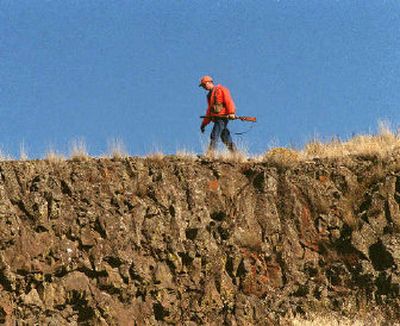
Stock up on shot shells and get the dog in shape. The buzz is that this could be an upland bird season to remember throughout much of the Inland Northwest.
The first alarm sounded at the end of August when the Idaho Fish and Game Department surveys found that booming chukar populations along the Salmon River’s Clearwater region have reached numbers not seen since 1984.
And although Washington no longer conducts official surveys, biologists say they’ve also seen large broods of chukars. And the most recent reports have been indicating that pheasants and quail joined the fertility party and had a big hatch, too.
Idaho continues to conduct aerial surveys at the end of August to track chukar populations. This year they counted more than 2,000 birds in a 12-square-mile area along the Brownlee Reservoir, or more than 173 per square mile.
The count is about 12 percent higher than last year, which was the highest chukar tally since 1987, department officials said.
In the Clearwater region, chukar numbers are generally similar to last year’s high numbers, said Dave Koehler, who conducted surveys on the lower Salmon and the Snake River upstream from Lewiston.
“Our surveys found the numbers down about 14 percent on the salmon upstream from the confluence with the Snake, but remember, last year had the highest counts ever in that area,” he said. “The numbers are very good this year, about 40 percent higher than the previous five-year average and that average includes last year’s record numbers.”
The counts in that area of the lower Salmon totaled about 125 partridges per square mile in the last week of August, Koehler said. Nearby on the Snake River near the confluence of the Salmon, the counts were up from last year to about 54 birds a square mile.
Chukar and Hungarian partridge hunters are limited to bagging eight partridge a day in Idaho or six a day in Washington.
Southeastern Washington biologists are seeing big broods of pheasants, said Pat Fowler, state wildlife biologist in Walla Walla. “They’re definitely a bright spot for us down here this year,” he said. “It could be one of the best pheasant hatches in a long time.”
Pheasant hunters smarting from Washington’s decision last year to postpone the season until late October, can take some solace in this year’s season extension into the middle of January, the first time in memory the season hasn’t been scheduled to end on Dec. 31.
Meanwhile, quail appear to be booming virtually throughout the region, from the Palouse and Snake River country west to Yakima and the Okanogan.
The report from Chelan, Douglas, Grant and Okanogan counties doesn’t get much better than this:
“We have no formal surveys, but there are quail or huns everywhere, more than I’ve ever seen before around here,” said Matt Monda, Washington’s regional wildlife manager in Ephrata.
Pheasants, of course, are not so populous in the Columbia Basin nowadays because of the changes in circle irrigation farming.
But quail that used to be found only in little pockets where people fed them can now be found all over the basin, Monda said.