
Watch, but don’t touch
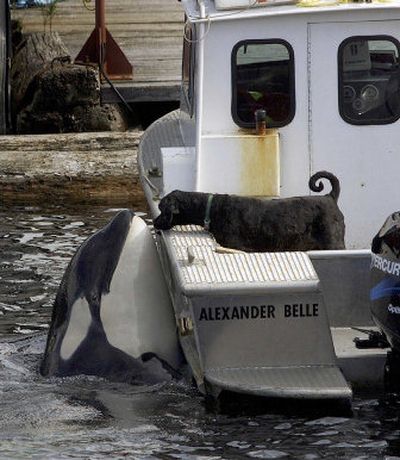

Luna, the only killer whale that lives in Nootka Sound off Vancouver Island, may be wondering why his adopted human family is rejecting him.
Until last year, he apparently considered those two-legged, camera-carrying people on boats were his ever-loving family.
No longer. This year his overtures are being ignored and to his consternation some ungrateful people even bang paddles to scare him away when he gets close to their boats.
He’s only 6 years old and still a toddler in the orca world.
My wife and I had heard that Luna was the most charismatic orca along the British Columbia and Washington coasts as we booked a two-day ride on the 63-year-old MV Uchuck 111, a 136-foot-long freighter refurbished for passengers.
It’s about 620 miles from Spokane to Gold River, home port for the Uchuck 111. After ferrying to Nanaimo on Vancouver Island, we drove about 120 miles to Campbell River and then 50 miles to Gold River.
Capt. Fred Mather and his crew impressed the 21 passengers when they smoothly and expertly unloaded 62 one-ton bales of fish food at two Atlantic salmon fish farms, a pickup truck and other heavy equipment to logging operations and kayakers and hikers to their destinations.
The captain’s wife, Glenda, presided over the galley, whipping up dishes so tasty the passengers frequently lined up to buy her food.
During our ride on the Uchuck 111 and at motels in Gold River and Zeballus, we learned that many residents of communities around Nootka Sound consider Luna a gold mine, Indians believe he is the reincarnation of one of their chiefs, many are ambivalent and others consider him a damn nuisance.
When he first appeared in the sound, he delighted boaters by sidling up to boats to be petted, played fetch and tug-of-war with boat fenders and squirted water at people. Now, boaters can be fined up to $100,000 for petting him. Fines have been painful to violators of the regulations, but none has been anywhere near the maximum.
Now that he’s learned he’s not welcome to come close to boats, he reacts much the same way as human toddlers act. He attracts attention by swimming near boats and then vanishing. He also destroys transducer sonar units on power boats and rudders on sailboats.
It’s not that Luna has become aggressive, Capt. Mather said. He just doesn’t like the rudders and transducers, adding that Luna has shown no sign of attacking boats. He’s a youngster who is becoming independent.
A few Nootka Sound residents believe Luna has developed an “attitude.” By that, they mean he’s becoming aggressive.
When I fished Nootka Sound with three Spokane friends a dozen years ago, Gold River was a company town almost entirely dependent on the company’s lumber mill. In 1998, when lumber prices plunged, the company closed the mill; the town was devastated. Jobs disappeared. Businesses went bankrupt. Real estate prices sagged.
Gradually, Gold River reinvented itself. It’s now a town that depends on fishermen, wildlife enthusiasts, mountain climbers, hikers, adventurers, history buffs and tourists. And, of course, Luna.
Luna attracts hundreds of whale lovers every year and those visitors spend a lot of money. The orca might swim in Nootka Sound for decades. Orcas aren’t considered adults until they’re 20 and they can live to be 50 years old. If he stays in Nootka Sound, he’ll be worth millions to area businesses.
For several months last year, Nootka Sound residents thought that the Federal Department of Fisheries and Oceans would succeed in capturing and reuniting Luna with his familial pod in the south end of Vancouver Island.
Then the Mowachaht-Muchalaht First Nations began a campaign to stop the feds from capturing Luna. At least some tribal members believe Luna is the reincarnation of their late chief Ambrose Maquinna, who, members say, promised to return to them as a whale. The chief died three years ago.
When the feds tried to capture Luna, the Indians managed for several days to lure Luna away from the capture pen. Finally, the feds gave up. Now the department is cooperating with the Indians in monitoring Luna’s activities.
Hauling freight to and from fish farms, logging operations and villages is the Uchuck 111’s bread and butter, Capt. Maher said. Accommodating passengers is the frosting on the cake.
The freighter chugged along at about 12 knots and hour. When it stopped to drop off freight, most of the passengers grabbed their cameras and headed for the upper deck to photograph the operations.
Several of the passengers seemed more interested in seeing bears, deer and other wildlife and identifying waterfowl and other birds than seeing Luna. Most carried high-powered binoculars.
Soon after we left Gold River a passenger spotted a whale’s high dorsal fin.
“It’s Luna,” he shouted. Within seconds most of the passengers, nearly all of them carrying cameras, were on the open deck looking for the whale.
Luna swam up in the wake of the freighter, his dorsal fin showing and then disappearing. Suddenly, he was just behind the freighter’s propeller. Passengers crowded around the end of the boat, hoping he’d surface. But he never did. All the passengers saw was his impressive shape just beneath the white water churned up by the propeller. Gradually, he retreated and vanished.
To many of the passengers, Luna’s brief appearance was a magical moment.
The freighter dropped off three kayakers, several hikers, tons of fish food at fish farms, equipment at logging operations and finally docked in the late afternoon at Zeballos, a turn-of-the 19th century gold mining town with four motels and satellite TV.
The next morning we picked up hikers, dropped off more fish food at a fish farm, saw numerous bears and some deer along the shore and then stopped for a half hour at the Nootka Island Lodge, one of the best-known fishing lodges in Nootka Sound. We watched fishermen prepare 30-pound chinook salmon for shipment back to Gold River.
Our last stop during our two-day trip was at Friendly Cove, the protected spot where Capt. James Cook arrived in 1778 with two sailing ships, the Resolution and Discovery. Life aboard a passenger-carrying freighter proved to be entertaining, educational and even exciting.