
A real lifestyle change
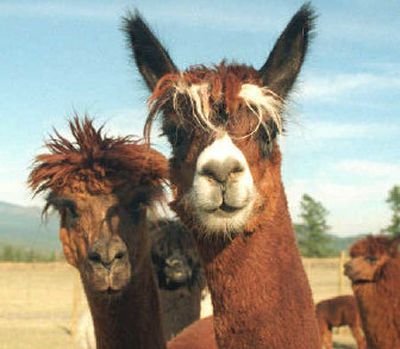
When Craig and Rochelle Fairfield moved just south of Coeur d’Alene and started their farm, Mica Glen Alpacas, their grown children were very surprised.
“We moved here from Denver, and my wife is originally from L.A., so this was a lifestyle change for us,” said Craig Fairfield. “This is our third year with alpacas. We just decided to build a barn and raise some interesting animals. We thought this would be a good way to enjoy our country lifestyle. There are so few alpacas in North America, and here we are, sort of pioneers trying to develop the growth of the herd and working to get mills to accept this fiber.”
And the Fairfields are not alone.
“Alpaca farming is becoming more popular,” said Carrie Hull, coordinator for the Northwest Alpaca Showcase which begins on Friday. “More and more people choose alpaca farming because of the lifestyle. A lot of people are leaving the corporate world and their 9-5 jobs for this. They enjoy being outside, caring for the animals and they also benefit from the therapy of owning the animals themselves.” She added that alpacas are one of the few farm animals who don’t have to be killed in order for the industry to be sustainable.
Hull points out that alpaca farming offers “vertical integration. Owners can care for animals, produce or sell products from a farm store” while using their personal expertise and background.
“People with marketing skills use them to sell animals, people with computer or Web site backgrounds can use this skill in alpaca farming,” she said. “People of all backgrounds have found alpaca farming a profitable and rewarding venture. I know a guy who started designing web sites strictly for alpaca farms, and now he has a farm.”
Rochelle Fairfield is a seamstress. “She makes draperies and clothes,” said Craig. “We discovered that we could shear alpacas once a year in the spring and use the fiber to make clothing.”
The Fairfields raise Huacayas alpacas.
“Their fiber is a very fine, usually straight fiber with some crimp in it,” explained Craig. “If you take an animal and push on it you’ll notice the fiber is dense and it’s difficult to see the animal’s skin through it.”
Rochelle has several looms for weaving and a spinning wheel, and her work is displayed at the Mica Glen Alpacas small farm store.
“We stock it with alpaca products that we buy also,” said Craig.
Kathleen Cullen raises Suri alpacas on her farm just outside Spokane, Foothills Suri Alpacas.
“Back in the 1970s I got interested in weaving and spinning,” she said. “One of the fibers that was really wonderful to work with was alpaca, however at that time there were no alpacas in this country. I was always intrigued with alpaca fiber.”
Suri alpacas have silk-like fiber. “It’s very lustrous,” she said. “So the alpaca suits made in Italy are usually made out of Suri alpaca because of this quality and its lovely draping.”
According to the Alpaca Owners and Breeders Association, alpacas, which were first imported to this country in 1984, were once cherished by the ancient Incan civilization in the high Andean Plateau and mountains of South America. These gentle, grass-eating animals live up to twenty years, weigh between 100 and 200 pounds, and are about 3-feet tall. They have no horns, hooves, incisors or claws.
Cullen said, “They all have their own personality. For the most part they are mellow animals. The worst that might happen is that they may kick when you are trimming their nails. But they are so small that you’ll just have a bruise.”
But this doesn’t mean they are pets, said Fairfield.
“If you raised a baby alpaca to be a pet, especially a male, it would become aggressive because it would see you as another alpaca,” he said. “They have to live their life in their herd.”
Both Cullen and Fairfield raise alpacas for breeding as well.
“The females are pregnant for eleven and a half months,” said Cullen. “When the baby is two to three weeks old the mother is the most fertile, so she’s bred again. The babies nurse for six months.”
Alpacas come in many colors, and you don’t always know what you are going to get.
“There is no guarantee as far as what color you’ll get unless you have a long history of male gene domination,” said Fairfield. “It’s interesting and most always a surprise.”
There are at least 22 colors of alpaca fiber, but the most desirable, said Cullen, is white. “You can dye it any color you want.”
Hull said this weekend’s alpaca showcase offers attendees hands on, close experience with the animals.
“Alpacas are enchanting and captivating,” she said, “so the No. 1 reason to come to the show is to meet an alpaca. The second reason is that we have a wonderful group of vendors this year. People can come and put together the animal with products that can be created with their fleece. There’s also a real Peruvian culture aspect since alpacas traditionally come from South America.”