
400h kicks hybrid tech into overdrive
Was Katrina the Big One?
Will history remember her as the storm that ransacked New Orleans, the straw that broke the back of the Bush administration or the moment Americans collectively realized the fragility of our petroleum-based economy?
All of the above? None?
Whatever the final fall-out from this summer of distress, it will almost certainly be remembered in the automotive world as a turning point in the march toward widespread acceptance of hybrid technology.
Case in point: For reasons too convoluted to relate here, I am on the deck of a handsome, beachfront on Long Island’s Hewlett Channel. The subject of cars comes up – and this is a community that appreciates its cars.
Driveways here are littered with Porsches, Lincoln Navigators, and Mercedes-Benz of all stripes. In the driveway next door, a Benz E-Class sedan and a Yukon Denali flank a beautifully maintained vintage M-B S-Class convertible.
“What about this new Lexus hybrid?” inquires my hostess when she learns I write about cars. She tells me she was a longtime Saab owner, but made the switch to Lexus when she bought an SC 430 a few years back. Now she’s thinking a hybrid might not be a bad idea.
Lexus says the wealthy are concerned less with saving a few bucks at the pump than in terms of convenience, and that one less fill-up per week means 15 minutes not wasted.
But that was before Katrina exposed the shakey underpinnings of our fuel supply and fuel prices soared past three bucks a gallon.
Now, everyone’s paying attention.
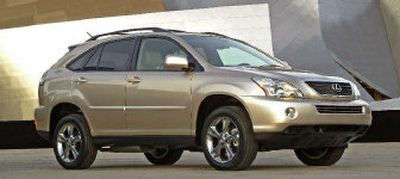
The RX 400h is based on the midsize luxury crossover RX 330, which long ago established itself as one of the best of that new breed. Aside from the hybrid system, they are essentially the same vehicle, right down to the 3.3-liter six-cylinder gasoline engine that gives the 330 its name. Lexus calls the hybrid the 400 on the premise that it performs like a 4-liter eight.
They have a point. The 400 is as much as a second quicker than the 330 from zero to 60, making the sprint in anywhere from 6.9-7.8 seconds, depending on whose stopwatch you trust.
As we should all know by now, electric motors produce far more torque than horsepower and torque produces acceleration. Conveniently enough, that production begins to drop off at almost exactly the same time that the gasoline engine is ready to pick up the pace.
There are three electric motor-generators abord the RX 400h. There’s one up front that handles the electrical chores — it provides power for the starter, the air conditioning, the power steering system and the like — and acts as a motor-driven generator. The one in the middle is the chief power source, driving the front wheels.
The third, rearmost, motor drives the rear wheels when conditions are sufficiently slippery to cause the front wheels to lose traction. Lexus says this unit is intended for light-duty use, and may overheat if run hard for extended periods.
All three motor-generators capture energy that otherwise would be lost, when the 400h is coasting and during braking, and turn it into electricity. With a full charge, the 400h is able to run on battery power alone. It can also run on just the gas engine, although it is most likely to use some combination of the two.
All told, the system produces 268 horsepower, 38 more than the 330. Lexus won’t release total torque numbers.
All this wizardry is harnessed by a continuously variable transmission, which uses planetary gears to turn the torque into useful power. Toyota says the CVT matches up better with the hybrd system than the five-speed automatic in the 330.
The battery pack, the heart of the system, is substantially improved over the second-generation design found in the current Prius. It’s lighter, has a higher peak power capacity and is packaged in a smaller, metal case with improved heat-rejecting capabilities.
Lexus introduces a new electronic stability control system on the 400h. Called Vehicle Dynamic Integrated Management (VDIM), it anticipates instability in all directions and proactively applies corrective measures via the anti-lock braking and traction-control systems.
A unique front bumper, grille and foglamps, and LED-style taillights are the only visual clues to the identity of the 400h. Tire fairings and underbody covers help maintain a .35 coefficient of drag, contributing to fuel economy.
On the inside, designers opted for brushed aluminum instead of wood trim to reflect the car’s techy nature, and an illuminated power meter replaces the tachometer.
Consistent with the marketing strategy Honda applies with its Accord, the 400h is fully equipped, adopting much of the 330’s optional equipment list as standard gear, including leather upholstery, sunroof, navigation system, backup camera, high-intensity discharge headlights and power-adjustable steering column.
Typical cost for a hybrid system is about $3,000. The premium paid for the 400h is about $9,000 but when the standard gear is factored in the differential drops to less than the three grand bump.
To my way of thinking, it’s a sound strategy. Those who can afford the premium are essentially underwriting the cost of developing a system that will become increasingly commonplace and, hence, more affordable.
Lexus doesn’t promise pie-in-the-sky fuel economy numbers; the RX 400h is rated at 31 city/27 highway, but they’re a far sight better than any other sport-ute produces. Plus, it’s rated as an ultra-low emmissions vehicle, which means plenty in terms of clean air.
Acceptance of hybrid technology had a full head of steam before Katrina smashed into New Orleans; that it’s now been kicked into overdrive ultimately may be seen as a welcome consequence of a terrible occurrence.