
From vine to wine
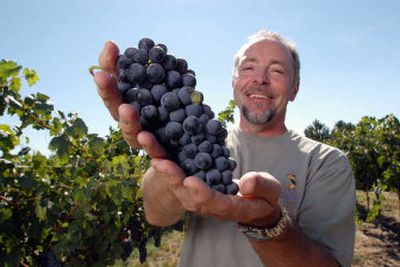
MATTAWA, Wash. — When Mike Scott arrived at a vineyard above the Columbia River, he pulled a few plump grapes from a cluster and popped them into his mouth.
He savored the moment.
“Mercy,” he said, “this will be good.”
It is harvest time in Central Washington, a time of year when the 350 winemakers in the state are teased by the potential of future wines.
It is also a time that reveals an agricultural oddity: farmers and customers actively working as partners.
Scott, like other winemakers in the state, routinely walks the vineyards. He inspects grape clusters, looks at the size of berries, checks on canopy growth that can let in too little or too much sun. And he talks to vineyard managers to discuss the finer points of the weather and irrigation. It is all part of a decade-long push that has made Washington the second-leading wine state in the country – a $3 billion player that seemed to mature overnight.
Though young by any measure, grape growers have planted more than 30,000 acres of vineyards across the dun hills stretching from the Walla Walla area through the Columbia and Yakima river valleys.
Turning this land from promise to profit took the right blend of soil, sun, temperature and entrepreneurism from grape growers and winemakers alike. Today there are just as many winemakers as grape growers.With an economic boom that helped introduce premium wines to the dinner tables across the country, along with savvy marketing, the Washington wine industry has captured attention and winemakers like Scott have reason to smile.
His Lone Canary winery is among 10 flourishing in the Spokane area.
At the vineyard outside Mattawa, a small town just a dozen miles down the Columbia River from where Interstate 90 crosses, vineyard owner Butch Milbrandt is pleased with his latest crop.
He planted the vines several years ago with a variety called barbera, on acreage that had been a field of Kentucky bluegrass.
Barbera is an Italian variety that’s about 400 years old – relatively new by wine grape standards.
Scott wants a grape that will yield a bold wine full of berry flavors. He plans to release this 2005 vintage in the spring, a quick turnaround for a red wine. Scott, though, wants the wine to best reflect the fruit from this vineyard. So rather than having it age in oak barrels, the big, bright flavors of the grapes he has tasted on a warm afternoon will be quickly captured.
Milbrandt has farmed for decades in the region, growing potatoes, wheat, sweet corn, hay and other crops. None of it has been as rewarding as growing grapes.
It’s a different kind of agriculture, where more is not necessarily better. That’s unusual in farming, where yield numbers are usually the best indicator of farm success.
By working so closely with winemakers, growers share some of the credit. They see their vineyards listed on bottle labels. There’s a special recognition unlike growing other crops where quality is important but largely unheralded outside of the industry. McDonald’s, for example, rarely highlights the Central Washington farmers who grow the fine potatoes sliced into the world’s most beloved French fries, nor do bakeries often credit the individual farms that grow wheat used to make breads and pastries.
It makes the experience of growing grapes more personal, Milbrandt said.
“Even the grower industry meeting is a lot more fun because you’re drinking wine instead of eating baked potatoes,” he said, smiling.
“““
The land on what’s called the Wahluke Slope has ideal soil and weather condition for growing wine grapes.
The soils include a surface layer of sandy loam that is about two feet deep, but it’s underneath where the secret lies.
A mineral-rich layer of sediments were deposited by the great Ice Age floods. The vine roots tap this layer, giving the grapes character.
These floods were caused by the emptying of giant Lake Missoula. Again and again during a time when ice sheets covered much of Canada and the Northwest, the lake that filled the valleys of Western Montana breached an ice dam near the spot where the Clark Fork River now drains into Lake Pend Oreille.
When the ice dam was breached over hundreds of years, the floods scoured Western Montana, rushed through north Idaho, and fanned out across Eastern Washington carving what we today call the scablands. Some of the water coursed down the Columbia River with its payload of minerals and sediment intact.
Downriver from the Wahluke Slope, the water hit a bottleneck and began to backwash and pool. This action deposited the sediment.
Fast forward 10,000 years and wine-grape growers are putting this catastrophe to work.
Besides the soils, the area is sunny, warm and dry. Even its breezy location is good for growing wine grapes, Milbrandt said, for winds also make vines struggle, which in turn intensifies the fruit.
Little rainfall during the growing season allows the careful manipulation of vines by Milbrandt and his vineyard crew.
The characteristics of the area are unusual enough, Milbrandt said, that vineyard owners are pushing to have the Wahluke Slope named as an appellation, or designated growing area.
Working closely, Scott and Milbrandt pick and eat grapes from up and down the rows. They talk about the sugar level in the grapes, called brix, and try to determine the pH, or acidity level.
The sugar will determine the alcohol content in this barbera wine, which needs to be at least 12 percent. Knowing a little about the acidity level will help Scott know how to treat the juice pressed from the grapes to ensure the young wine has balance when poured this spring from his tasting room on the 100 block of South Scott Street.
Scott, an Englishman who came to Spokane more than a decade ago, is descriptive about wine.
He compares drinking wine to dating. “You have to take chances,” he said. “You can only sit at the bar for so long before you have to get up to make your move.
“Some wines, like dates, are good for just one night.”
Others surprise, he added.
“It’s an adventure. A grand one.”