
School’s personal approach paying off
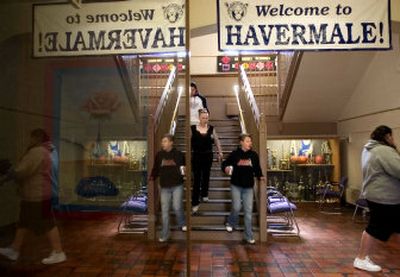
Fred Schrumpf’s office is the office of last chances; the last stop of last stops for kids who have fallen through the cracks.
The Havermale High School principal knows this. So when 16-year-old Tom enters his office to see if he can swap a math class for an art class, Schrumpf doesn’t hesitate to let the teen explore his interests. Tom likes art.
“Whatever I can do to keep you here,” Schrumpf tells the boy.
Keeping students at school seems to be the biggest challenge for Schrumpf and his staff at the Spokane public school.
About 40 percent of the students at the district’s alternative high school are more than a year behind in credits. On average, only two-thirds attend classes each day. Last year, 65 percent of students dropped out after 90 days.
But recent data shows that the administration and teachers at the school are working hard to change those figures. New academic and disciplinary programs are paying off.
So far this year the number of students suspended decreased by 59 percent. The number of days students missed because of suspensions decreased 78 percent.
Fighting is down. Disruptive and defiant behavior is down.
At Havermale, students are starting to see the school not as an alternative for troublemakers, dropouts, druggies or teen moms, but as a small high school with an environment that is more personal and fits each student’s needs.
“We’re trying to change the culture here to show that these students are capable people,” Schrumpf said. “They’ve had some bumps in the road, but they can succeed.”
Like other alternative high schools across the nation searching for ways to bring disengaged learners back into the classroom, Havermale took a page out of a national report called “Engaging Schools.”
The report, prepared by the Board on Children, Youth and Families through the National Research Council and Institute of Medicine based in Washington D.C., calls for promoting a sense of belonging, and creating personal relationships with students by showing an interest in their lives.
Each morning Schrumpf and Vice Principal Jay Jordan are posted at entrance doors to the school offering salutations to each student by name. Most days administrators will also sit down and eat lunch in the cafeteria with students.
“That is where they see you, and might tell you about what’s going on,” Jordan said. “It prevents nine out of 10 problems from starting.”
A new in-school intervention program is also a central part of the decline in discipline problems. Instead of suspending students for disruptive behavior, students are sent to a portable classroom near campus for mediation, tutoring and mentoring.
“We’ve had kids say ‘Just suspend me.’ ” We say, “No way,” Schrumpf said. “The more the kids are suspended, the longer they are out of school, and the more disengaged they become. Classroom time is sacred.”
Although the majority – about 320 students out of 460 enrolled at the school – attends school for six-periods in a modified block schedule, there are also contract-based programs, where students do work outside of school and check in once a week, and general equivalency degree preparation programs, in lieu of a high school diploma.
A cohort of 40 students is enrolled in a new College-Bound Competency program this year, for students who have the capacity to graduate on-time, and go on to college.
The college component is huge for Havermale students. For many it once seemed so far out of reach.
Like for 17-year-old Caitlin Keogh, who dropped out as a freshman student at Shadle Park High School. Keogh now gets A’s, is involved in a leadership class at Havermale, and is set to graduate this year and possibly enroll in college.
“You have the chance to have more of a voice here,” Keogh said. “We’re not a bad school, we’ve just had this bad reputation. That’s changing.”