
Gingrich sees safer health care
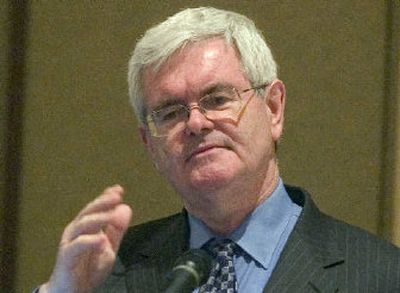
When he was Speaker of the U.S. House of Representatives a decade ago, Newt Gingrich set out to revolutionize American politics with broad tax cuts and massive welfare reform.
Since leaving Congress in 1999, Gingrich has turned his attention to trying to revolutionize the American health care system. During a symposium Tuesday in Spokane, he predicted Americans will use technology and more-accessible information to make health care safer and more affordable than the system we now use.
In 2003 Gingrich launched a nonprofit advocacy group, the Center for Health Transformation. He makes regular visits to medical conferences to preach the gospel of medical system reform. He is also a regular contributor to the Fox TV news network.
“I now spend 40 percent of my time on national security and 40 percent of my time on health care. I think health care is 30 times more complicated,” Gingrich told about 350 people during a medical symposium held at the Davenport Hotel.
He was the featured speaker during the two-day Northwest Medical Informatics Symposium hosted by Inland Northwest Health Services, a Spokane-based nonprofit that coordinates some regional medical services.
As large as the health care problem is, Gingrich argues that American ingenuity and technology will change the way the country receives services and manages its medical records.
“America is a country of inventors. Something we do well as a country is to focus on a … problem and come out with a dramatically better solution,” he said.
Technology, he predicted, will help consumers and practitioners track and report the level of care, the costs involved and outcomes of the entire medical system.
He cited the use of a Florida Web site, MyFloridaRx.com, which gives patients an instant list of drug pricing for any ZIP code in that state. When introduced, the site showed some drugs varied in price by 600 percent between pharmacies located near each other.
“That disparity ended almost right away,” said Gingrich.
Gingrich said the Spokane medical community is a model for record sharing. Designated a regional health information organization, INHS and other entities in the Inland Northwest have become pioneers in sharing data between regional hospitals and doctors’ offices, said Gingrich.
“The only other regional system I know of that’s doing something similar to what you are is Cincinnati,” he said.
Improvement in the health care system depends on the industry embracing transparency and complete electronic record-keeping, Gingrich said.
Once such open data-reporting occurs, consumers will not endure substandard services and overpriced care, he said.
“People will ask, ‘Why are we sending four times more money to hospital A (for services and care) than to hospital B when hospital be gets better results?’ ” he said.
Among other efforts, the Washington, D.C.-based Center for Health Transformation last year helped launch a collaborative Web site — www.rhiowiki.com — that lets medical groups share information about regional health information organizations.
Gingrich also advocates a well-supported federal initiative to standardize patient records. Once that’s done, individuals will amass an evolving medical record that will be instantly accessible by any hospital or doctor they visit over time.
“That’s something we could have used after Katrina,” when thousands of patients had their medical records washed away, Gingrich told his audience.
“They ended up trying to resurrect their medical histories from scratch,” he said.