
Horse owners warned of West Nile threat

When it comes to West Nile virus, Washington and North Idaho horse owners have been pretty lucky up to now.
But don’t bet the farm on the disease not hitting hard this year.
“You’ve got to look at how the disease has progressed,” said Washington State Veterinarian Leonard Eldridge. “Right up to the Washington border – there’s a pretty good chance this year.”
In fact, the first confirmed case of West Nile infection acquired by a horse in Washington occurred last September near Prosser, according to the state Department of Agriculture. Before that the virus showed up in a single crow in Newport. No humans have been infected in Washington, and North Idaho has been spared, as well.
Eldridge urged horse owners to vaccinate their animals as soon as possible. The vaccine requires two doses four to six weeks apart, and horses won’t be immune until five weeks after the second shot. Horses should be given a booster shot at the start of mosquito season every year thereafter. Human vaccine is not yet available.
Symptoms in horses include loss of coordination, loss of appetite, confusion, fever, stiffness and muscle weakness, particularly in the hindquarters.
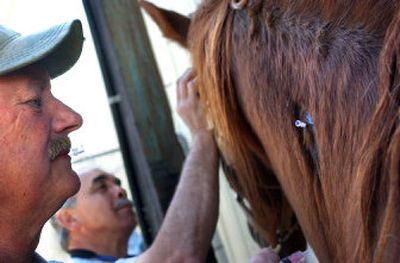
Veterinarian Jerry Ponti was vaccinating horses in Liberty Lake on Thursday, as he has for about three years.
“There’s no treatment for it,” Ponti said. “Most people use steroids and anti-inflammatories (on sick horses) and hope for the best.”
Though Washington is the last state in the Lower 48 not to have seen a human case, West Nile has hit other Western states hard, Ponti said.
The Department of Agriculture said West Nile, which is spread through the bite of a mosquito that has previously bitten an infected bird, is fatal in 30 percent to 40 percent of horses that contract it. The virus can infect people, horses, many types of birds and other animals. Infected horses do not spread the disease.
Ponti charges $27 per vaccination.
Though West Nile has not appeared in North Idaho, Southern Idaho has seen plenty. Last year, 13 humans and 106 horses contracted the virus, mostly in late summer, according to the Idaho Department of Health and Welfare. Department spokesman Tom Shanahan said the virus appears to be traveling west in migratory bird routes along river valleys, particularly the Snake River in Idaho.
Wayne Hoffman, a veterinarian who practices in Idaho and Washington, stressed the importance of getting horses vaccinated. “It’s been shown that the mortality rate for horses that are vaccinated is significantly lower,” Hoffman said.
Eldridge also recommended horse owners take measures to reduce mosquito habitat, such as standing water in yards, troughs, or birdbaths.