
Peppy Mazda5 eyes growing niche

Third-row seating is the automakers’ new Holy Grail.
Three rows have been stuffed into full-size wagons, large and not-so-large SUVs and even the latest-generation cute-utes.
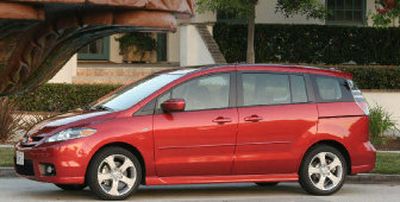
But Mazda takes the strategy to new extremes with its new-for-‘06 Mazda5, a small, front-drive, “multi-activity vehicle” with a budget-friendly price tag.
It’s the smallest vehicle extant bearing seating for six.
Starting at right around $18,000, the Mazda5 aims for a young, urban cohort. With EPA economy ratings of 21 city/26 highway, it will appeal to those for whom $3 gas is a concern and who occasionally have an extra passenger or two.
It truly had better be occasional, though; as small as this rig is, the twin, third-row seats are essentially incidental. Thanks in part to second-row seats that slide fore and aft, it is possible to squeeze a pair of adults back there but they won’t be happy for long.
They won’t complain about the view, though; each row is 2 inches higher than the one ahead, ensuring views all around. And, happily, the Mazda5 makes good use of all available space. Front-seat door pockets include water-bottle holders; storage bins hide beneath the second-row seats; and a covered tray contains incidentals behind the third row.
All seats fold away easily for maximum flexibility and small, sliding doors on either side provide easy access to the entire area, which, with all four rear seats folded, measures 5 feet in length and 44.4 cubic feet of total volume.
It’s a nifty bit of packaging in a rig that’s both attractive and engaging.
The Mazda5 is the second-smallest member of Mazda’s increasingly eclectic family of vehicles. Unlike the Mazda3 below it and the Mazda6 above, which offer sedan iterations, it’s available only as what can only be called a mini-minivan.
Built on the Mazda3 platform, it’s 5 inches longer and 6 inches taller than its sibling and rides on a wheelbase that’s 4 inches longer. It’s also loaded with gear that’s only available optionally on most competitive vehicles — although in truth it faces virtually no direct competition in the United States.
It’s a different story in Europe where the Mazda5 squeezes into a category that racks up annual sales of 800,000 units and is still growing.
The Mazda5 is available in two trims — Sport (from $17,995, including destination) and Touring ($19,510) — and comes equipped with power windows, mirrors and door locks; remote keyless entry; cruise control; steering wheel-mounted audio controls; a full complement of airbags (including curtain-style bags that cover all three rows); 17-inch alloy wheels; and four-wheel disc brakes backed with an anti-lock system that includes brake-force distribution and brake assist.
Touring models add automatic climate control; front fog lamps; rear spoiler; side sill extensions; an in-dash six-CD changer; and power moonroof.
A 157-horsepower, 2.3-liter, four-cylinder engine powers both trims. It’s a slick little, all-aluminum unit, with 16 valves, double overhead camshafts and a variable induction system that broadens the useful torque band.
The base transmission is a five-speed manual, but our tester was equipped with the optional four-speed automatic. A four-speed is a clear deficit in this era of five-, and even six-speed automatics – more gears allow for a better balance between performance and economy; however, this one makes clean, quick shifts and has a manual-shift mode.
Perhaps because it has staked out the youth market, Mazda has fallen prey to a touch of harmless but silly jimcrackery: the number of the operative gear appears in a digital display in the gauge panel. That can be a helpful touch when you’re rowing your own, but is a touch superfluous when the gearbox is in full auto mode.
Besides, why highlight a competitive weakness?
The free-revving little four is plenty willing with a single occupant aboard, but has little reserve for passing at highway speeds (here’s where another gear would be helpful), and I suspect it would labor mightily if hauling a full load of people and/or cargo.
A fully independent suspension, with front and rear sway bars, dishes up a ride that is surprisingly smooth and comfortable. Despite its height, the Mazda5 is stable during quick transitions, but fast sweepers taken aggressively produce a bit too much lean.
The rack-and-pinion steering system gets an electro-hydraulic assist for a good, sturdy feel at all speeds and is quick and accurate. True to its urban mission, the Mazda5 boasts a short turning radius, making it easy to park and maneuver in traffic.
The steering wheel tilts and telescopes and the driver’s seat is adjustable for height, so finding a comfortable driving position is simple.
In the end, the Mazda5 is a vehicle aimed at a growing niche. It’s moderately fun to drive (though it’s no sport-car-in-wagon-guise, as Mazda would have it) and its combination of features, price and adaptability should find it a ready market in the United States, especially as gas prices continue their inevitable, upward climb.