
No letup, Israel says

JERUSALEM – Israel’s prime minister declared Monday there would be no cease-fire with Hezbollah guerrillas, saying. “We will not give up on our goal to live a life free of terror.” His Security Cabinet approved widening the ground offensive.
Although Israel had suspended most airstrikes on south Lebanon for 48 hours, its warplanes struck deep inside the country early today. They hit an area that is a stronghold of Hezbollah guerrillas, witnesses said. Warplanes also hit Hezbollah fighters battling with soldiers near the border as the guerrillas fired mortars into Israel.
The cutback in Israeli airstrikes and a pause by the guerrillas in their rocket attacks on northern Israel brought both countries their quietest day Monday since the conflict began three weeks ago.
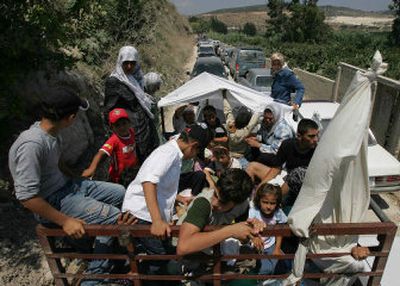
Thousands of Lebanese fled north in overflowing trucks and cars. About 200 people, mostly elderly, escaped the border town of Bint Jbail, where Israeli troops and Hezbollah guerrillas fought their bloodiest clashes. Two residents died on the road out, one of malnutrition, the other of heart failure.
Some survivors described living on a piece of candy a day and dirty water as the fighting raged.
“All the time, I thought of death,” said Rimah Bazzi, an American visiting from Dearborn, Mich., who spent weeks hiding with her three children and mother in the house of a local doctor.
The lull was felt across northern Israel, too. In the town of Nahariya, residents who had been hiding in shelters for the better part of three weeks began emerging. Supermarkets were fuller than before and more people were in the streets, walking along the beach and shopping.
But diplomatic efforts to end the crisis faltered despite increased world pressure for a cease-fire after the devastating strike in Qana.
Israel’s Security Cabinet approved widening the ground offensive today, a participant said, and rejected a cease-fire until an international force is in place in Lebanon. The participant, speaking on condition of anonymity because he had not been authorized to talk to reporters, said Israel’s airstrikes would resume “in full force” after the 48-hour suspension expires in another day.
The ground forces will move deep into southern Lebanon to the Litani River, about 18 miles north of the border, and hold onto the territory for several weeks until a multinational force can be deployed there, a senior Israeli government official said today.
Thousands of army reserves have been called up in recent days in advance of the decision, which is expected to lead to sending more troops into the border area. Israeli leaders have said they want to carve out a zone about a mile wide that would be free of Hezbollah.
Israel called the 48-hour suspension after the Qana attack to give time for an investigation – though it said its warplanes still would hit urgent Hezbollah targets, and at least three strikes took place Monday.
Jet fighters struck Hermel, 75 miles north of the Israeli border in the Bekaa Valley in eastern Lebanon. Warplanes fired at least five air-to-surface missiles on the town, witnesses said. It was not clear what was hit and whether there were any casualties.
Another strike targeted an area near the Syrian border, about six miles north of Hermel.
Many of those living in the northeast are Shiite Muslims, Lebanon’s largest sect from which Hezbollah draws support.
Israeli Prime Minister Ehud Olmert apologized for the civilian deaths in Saturday’s strike, in which 56 people, mostly women and children, were killed.
“I am sorry from the bottom of my heart for all deaths of children or women in Qana,” he said. “We did not search them out. … They were not our enemies, and we did not look for them.”
But he insisted Israel, which began its offensive after Hezbollah had snatched two soldiers and killed three others in a cross-border raid July 12, had no choice but to fight.
“There is no cease-fire – there will be no cease-fire,” he said. “We are determined to succeed in this struggle. We will not give up on our goal to live a life free of terror.”
President Bush resisted calls for an immediate halt to fighting, underlining that any peace deal must ensure that Hezbollah is crippled. He said Iran and Syria must stop backing the Shiite militant group with money and weapons.
“As we work with friends and allies, it’s important to remember this crisis began with Hezbollah’s unprovoked attacks against Israel. Israel is exercising its right to defend itself,” Bush said.
Secretary of State Condoleezza Rice said earlier in the day she expects a U.N. resolution for a cease-fire within a week. But as she headed to Washington after a visit to Jerusalem derailed by the Qana strike, she struck a more pessimistic tone.
“There’s a lot of work to do,” she told reporters. “You have to get all the work done; you have to get it done urgently.”
The central focus for a peace deal has been the deployment of a U.N.-mandated international force in southern Lebanon to ensure guerrillas do not attack Israel. But details of the force still must be worked out. With talks continuing, the United Nations postponed a Monday gathering meant to sound out contributions to a force.