
Rebecca Nappi: Pools preserve community health

On Monday, July 24, the temperature hovered near 100 degrees. At 6:30 p.m., children crowded together outside Liberty Pool in east Spokane, anticipating open swim. I walked by the children, carrying an awful truth: The pool was broken. There would be no swimming this night.
I uncovered the information an hour earlier, because it was the first night of swimming lessons for my 5-year-old great-nephew, Hayden. Instead of jumping in the water, the class fidgeted during a poolside safety session.
Later, Tony Madunich, park operations division manager for Spokane Parks and Recreation, told me that the pool’s main recirculation pump automatically shut down because of an unexplained hole in a pipe. The kids didn’t care why the pool was broken. They just felt disappointed.
I’m a pool rat this summer. My goal: Generate dialogue about Spokane’s looming pool crisis. The city’s indoor pool at Shadle High School will close permanently this school year, and the city’s five outdoor pools need major work. Taxpayers will most likely be asked to foot the bill for revamped outdoor pools and/or a possible indoor aquatics facility.
I intended to spend time in July taking dips in rural pools within 90 minutes of Spokane to explore how smaller communities do swimming for their children. But then I got bronchitis, and then I decided to hang out with Hayden at his lessons, and then I was asked to help time a swim competition at Witter Pool in north Spokane. The cosmic message: Swim the water in front of you. So I did. (August goal: those rural pools.)
Anyway, I realized that if we don’t retain a vital aquatics program in Spokane, the following will happen:
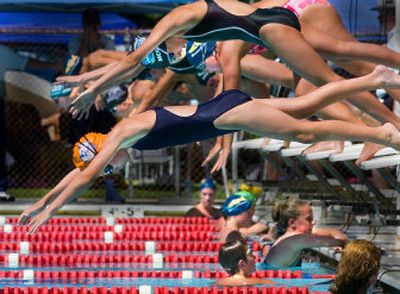
Our children will get chubbier. Inland Empire A/B Swimming Championships were held at Witter Pool on Friday, Saturday and Sunday. More than 400 young people, ages 6 to 19, gathered from throughout the Inland Northwest.
Since 1980, the percentage of obese young people has more than tripled, according to the Centers for Disease Control and Prevention; 16 percent of kids ages 6 to 19 are now overweight. The young people at the swimming championships, however, had long, lean muscles. Their lungs were strong from aerobic workouts.
Our children will get more isolated. At Witter Pool, I chatted with Emri Moore, 12, and Kyle Marsh, 13, of Spokane Area Swimming, a USA Swimming club. They were up and preparing for the championships by 7 a.m. Friday. If they didn’t have summer swimming, they told me, they would sleep in, then watch TV or spend time on their computers.
“You meet a lot of friends,” Emri said about swim meets.
The era when unsupervised children played outside all day is gone forever. Children whose parents can’t afford camps, lake cabins, pool-club memberships or water-park passes can really get trapped inside during summer’s dog days.
Our children won’t learn how to swim. At Liberty Pool, Hayden’s fear of water is evolving into a fever for it. His teacher, 20-year-old Sarah Armstrong, fell in love with swimming as a child, became a lifeguard at 16 and now passes on her passion to the guppies among us.
The chain of lifelong swimming begins during childhood lessons. For some, these lessons lead to lifeguarding and competitive swimming. For others, swimming becomes a sport that grows with them into older age, gentle on the joints and the spirit.
If we give up our neighborhood pools – most Liberty area kids walk there – some children might never learn to swim, breaking an essential link in this chain of community health. We can’t afford to lose it.