
Northern Israel hit by 230 rockets
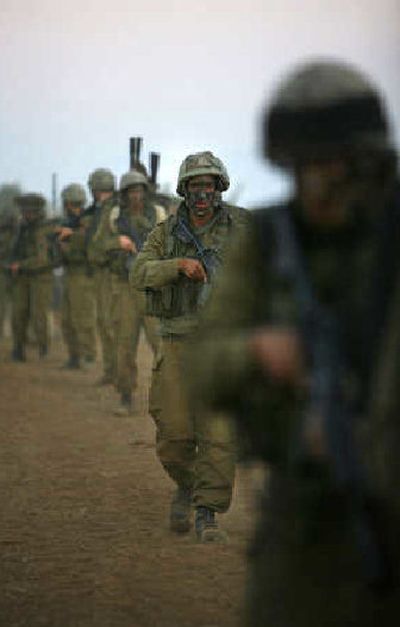

METULLA, Israel – Hezbollah fighters pounded northern Israel on Wednesday with their largest rocket barrage to date, defying three weeks of punishing air attacks and an ongoing ground offensive by thousands of Israeli troops who say they have seized up to one-quarter of southern Lebanon.
An Israeli man was killed on a kibbutz north of the coastal town of Nahariya by one of the more than 230 rockets that rained down on northern Israel, setting fires, smashing buildings and injuring dozens of people. Two rockets fell in the West Bank, about 40 miles south of the Lebanese frontier, the deepest such strike to date.
Across a sprawling northern front, Israeli forces shelled Lebanese border villages and launched more airstrikes after a 48-hour lull in attacks. Israeli planes hit dozens of targets before dawn today, including strikes on Beirut’s southern suburbs, the first in nearly a week.
On the ground, as many as 10,000 Israeli troops were in action, military officials indicated. One Israeli soldier was killed and four hurt in the massive operation, which is aimed at pushing Hezbollah fighters away from the border.
Diplomacy continued to founder. France, which authored a draft U.N. cease-fire resolution and could provide troops for any international force deployed in southern Lebanon, announced that it would not take part in a meeting today of countries that might contribute soldiers. In Rome, Pope Benedict XVI appealed for a halt to the conflict, which has killed at least 540 Lebanese and 55 Israelis.
Hezbollah said it had used Syrian-made Khaibar 1 rockets for the strikes that hit the West Bank near the Israeli town of Beit Shean in the Jordan Valley, fueling fears that it possesses long-range rockets.
With the fighting now in its fourth week, Hezbollah’s ability to keep firing rockets has been a source of surprise and dismay to Israeli commanders, officials and the public alike. The nearly 1,800 rockets fired amount to the most concerted attack on Israeli towns and cities since the war of independence in 1948.
Israeli commentators have raised questions about why Hezbollah was allowed to assemble such an arsenal after Israel’s withdrawal from southern Lebanon in 2000.
“The government and the army had six years to prepare the home front for the rocket threat, to obtain detailed and precise intelligence on Hezbollah’s missile arrays and fortifications, to develop or acquire weapons able to neutralize high-trajectory fire,” Uzi Benziman wrote in Wednesday’s editions of Haaretz.
The stepped-up rocket attacks by Hezbollah came hours after an early-morning raid by helicopter-borne Israeli commandos in the northern Lebanese town of Baalbek, in the eastern Bekaa Valley. The raiders captured five Hezbollah members and killed at least 19 fighters, the Israeli military said.
Lebanese authorities reported civilian casualties in the strike. It was not immediately clear whether those fatalities were included in the toll reported by Israel.
The first rocket-caused fatality in eight days on the Israeli side was identified as a 52-year-old man who had emigrated from Boston about 20 years ago. He was hit while bicycling home in the tiny community of Kibbutz Saar after warning sirens sounded, Israeli media reported.
Israeli warplanes Wednesday mounted wide-ranging airstrikes, hitting about 100 targets described as Hezbollah structures, rocket launchers and launch sites. The Israeli army said it had no information on reports that a Lebanese military base in the village of Sarba was hit, killing a soldier.
Commanders say they are focusing on a strip several miles deep, but they also have said that some troops have pushed north past the Litani River, as far as 12 miles into Lebanon.
Israeli forces have established control over one-fifth to one-quarter of southern Lebanon, said Brig. Gen. Guy Zur, who commands a combined armored and infantry division deployed in the area. Zur told reporters that Israeli troops were fighting Hezbollah guerrillas in about a half-dozen villages along a 25-mile stretch of the border and that the resistance was stiff.
Clashes broke out in Aita Shaab on the western end of the front, as well as in Bint Jbeil, the scene of fierce fighting a week earlier, and Taibe, a few miles from the border near Metulla. The Israeli army said five soldiers were wounded in the day’s fighting, but most of the injuries were slight.
Zur estimated that Hezbollah had had 1,000 to 2,000 full-time fighters at the outset of the conflict but had lost as many as 300. He said that Israel was “ready to deepen our operations” in order to root out Hezbollah from areas nearest the border and that it would act in all parts of Lebanon if deemed necessary.
Although U.S. Secretary of State Condoleezza Rice and other mediators had expressed hopes that a cease-fire could be in place by sometime this week, commanders and senior Israeli officials said fighting could go on considerably longer. Zur said it might take the army “a few weeks” to meet the goals it has set.
After some bruising battlefield encounters earlier in the conflict, Israeli commanders appeared to be basking in the success of the first helicopter-borne raid deep inside Lebanese territory.
Army Chief of Staff Lt. Gen. Dan Halutz said Israeli forces had gained what could be valuable intelligence during the commando strike in Baalbek, about 60 miles northeast of Beirut, the Lebanese capital. During the raid on a hospital building that they said served as a Hezbollah office complex, soldiers seized weaponry, documents and computer disks, commanders said.