
School projects threatened by rising costs
Escalating costs of building materials and a shortage of trades people could leave Spokane Public Schools up to $23 million short for capital projects planned over the next three years.
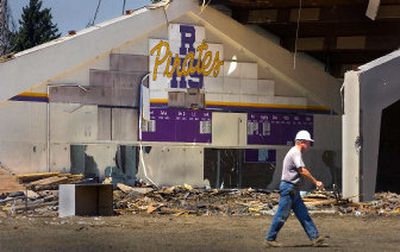
Renovation under way at Rogers High School may cost $7 million more than the estimated $59 million set in February, school officials said. The remodel of Shadle Park High School, still two years out, may cost nearly $70 million, or $10 million more than planned.
Other smaller capital projects, including new heating and ventilation systems for two elementary schools and new integrated security systems for school buildings, will also cost more.
The remodeling and other projects are all part of the 2003 capital improvement bond passed by voters.
“It’s unprecedented,” said John Mannix, the executive director of facilities and planning. “For the last 20 years in the Spokane area, we’ve typically used a figure of 3 percent in inflation per year. … In the last couple of years we’ve seen 15, 18 to 20 percent. It’s been crazy.”
Spokane joins school districts across the region struggling with a volatile construction market.
In Coeur d’Alene, soaring costs prevented the planned construction this summer of an additional four classrooms at the Coeur d’Alene Charter Academy and a remodel of the school’s science facilities. The charter school’s board of directors had wanted to spend about $800,000, but the lowest bid came in at $1.2 million.
“It was well beyond our comfort zone,” said Glenn Mabile, the school’s business manager.
Mabile said the science wing remodel will happen this year, but the new classrooms could take a few years.
A number of factors, such as Hurricane Katrina and international demand for materials in places like China and India, have caused the price of goods such as steel, concrete and sheetrock to skyrocket, officials said. The rising cost of petroleum is also causing problems.
“You add on top of that, in our neck of the woods is this incredibly active construction marketplace, both in the private and public sector,” said Ralph Rohwer, a Seattle-based consultant for Heery International.
Heery tracked 32 school construction projects in Washington, Alaska and Idaho and found that slightly more than half of the projects are at least 10 percent over budget, Rohwer said.
The bid accepted by the Mead School District in May was 40 percent more than budgeted for a new elementary school on Five Mile Prairie.
The Central Valley School District, still grappling with a failed bond this spring, added $20 million to a bond measure set for the November elections because of rising construction costs.
“The dilemma is we want to do the jobs we do well. We don’t want to undermine our durability” by cutting corners to save costs, said Spokane Superintendent Brian Benzel.
Spokane is trying something new with its remodels, using Garco Construction, the general contractor, as the project manager.
The district, architects and Garco worked together during the design phase, and on into construction. Typically, districts wouldn’t know who the contractor was until bidding time, leaving room for steep changes in estimated costs. The profit margin for the project was also set ahead of time.
“But it doesn’t buffer us completely from cost increases,” especially materials, Benzel said.
On Wednesday, the school board set a maximum price for construction costs at Rogers at $50.4 million, which doesn’t include items like architectural services. The total tab may hit $66.7 million, up from an estimate of $59.7 million.
Contractors are also favoring private jobs, because the profits are higher and the risks lower, Rohwer said. There is so much demand that contractors lack skilled people to do the work.
That means fewer and more expensive bids for public projects, such as schools.
“Because of this highly active market … we start losing competition,” Rohwer said.
Six contractors were given plans for Mead’s new elementary school in May, and only three submitted bids, said John Dormaier, director of district facilities and planning.
Mead voters approved a $37.7 million capital bond in 2004 to build a new elementary and middle school.
The elementary school project was budgeted at $151 a square foot, and came in at $212 a square foot. The middle school was budgeted at $161 a square foot, and is estimated to be $226 a square foot when the district opens bids in mid-September, Dormaier said.
“We would normally plan for a usual amount of escalation in our budgets, but it’s just ratcheted up out of sight,” Dormaier said.
Mead used additional state matching funds allocated for school construction last year to make up the gap, Dormaier said. During the last legislative session school remodels received the same financial backing as new buildings.
“But (those funds) have pretty much been consumed. We’re right on the edge in terms of not having a comfort zone,” Dormaier said.
Spokane also used additional state funding to fill some gaps, but still may have to start scaling back plans or phase the renovation of Shadle Park, set to begin in 2007, or do away with some smaller annual projects, Mannix said.
“We’re looking at all of that. Nothing has been determined yet,” he said.
The district could also run a bond issue a year early in 2008. Another capital bond is planned for 2009.
Voters in the Post Falls School District approved a $10.87 million levy in May for the construction of a new elementary school, the addition of eight high school classrooms, a land purchase and a renovated bus facility. Estimates for the projects considered inflation, district business manager Sid Armstrong said, so he doesn’t expect rising construction costs to be a problem.
“The proof in the pudding will be next winter when we get the bids, but at this point I think we feel pretty confident that the dollars we got are going to do the projects that we outlined,” Armstrong said.