
Fueled by a bargain

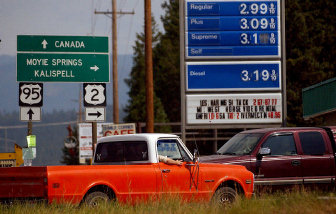
BONNERS FERRY, Idaho – Stu Grant was a bit wistful as he filled up the gas tank in his camper at an Exxon station 35 miles south of the Canadian border. “It’s the last of the cheap gas,” said Grant, who lives in Alberta.
Grant and his pal, Ken Robertson, were on the final leg of a 3,000-mile road trip that took them to Monterey, Calif., to watch motorcycle races. On the way, they got used to American prices at the pump.
“The highest we paid was something like $3.30 per gallon,” Robertson said.
That’s dirt cheap for the two Canadians.
In their hometown of Calgary – sometimes called “the Dallas of the North” for the vast oil and gas reserves surrounding it – gasoline costs $1.10 per liter. In U.S. dollars, that works out to nearly $4 per gallon.
In Bonners Ferry, Idaho, the two men paid $2.96 per gallon.
With the summer travel season in full swing, millions of Americans are hitting the road. They’ll grumble about filling up for $3 per gallon, forgetting it’s still an enviable price by world standards.
In Europe, drivers are paying $6 or more per gallon (try $7.30 per gallon in Norway). Even nearby Canada is a reality check for how much the rest of the world shells out for gasoline.
In Creston, British Columbia, a 50-minute drive from Bonners Ferry, Rick Gordon recently paid $1.18 per liter to fill up his Harley motorcycle. A liter is roughly the size of a quart.
Gordon, his brother Steve, and their friend, Frank Brauer, were on a trip to Vancouver Island to go salmon fishing. Gas was a small part of their budget; on their motorcycles, they average about 80 miles per gallon. But rising prices still weighed on their minds.
The price of gas has roughly doubled since early 2004. Rick Gordon said the rapid rise stumps him.
Alberta has enough petroleum and natural gas reserves to fuel all of North America for the next 40 years, according to the Alberta Energy and Utility Board. With that kind of resource in his figurative backyard, Gordon thinks prices should be cheaper.
“We’re paying the equivalent of $4 per gallon, and we produce it,” said Gordon, who lives in Calgary.
Unfortunately, it’s not that simple, according to economists. Petroleum prices are set by world markets, which fluctuate on supply and demand and investors’ jitters. Country-by-country differences, meanwhile, are heavily influenced by gasoline taxes.
In Canada, federal and provincial taxes account for 40 percent to 50 percent of the price at the pump, according to the Canadian Automobile Association. In the United States, gasoline taxes are much lower.
In Washington and Idaho, for instance, only 16 percent to 18 percent of pump prices can be attributed to federal and state taxes.
“We all pay the same thing on the open market. They just slap a lot of their taxes on their gasoline prices,” said Mantill Williams, the American Automobile Association’s director of public affairs in Washington, D.C.
Since governments have different tax structures, straight comparisons of gasoline prices are a bit unfair, said A.F. Alhajji, associate professor of business at Ohio Northern University. Though gas taxes are higher in other countries, their residents get breaks in other areas, he noted.
“I wouldn’t mind paying $7 per gallon for gasoline if I got free health care,” Alhajji said. “I wouldn’t mind paying $7 per gallon if I got six weeks of vacation. I wouldn’t mind paying $7 per gallon if I could drive my car 150 mph on an autobahn.”
But lower gas prices do give the U.S. economy an edge, he added. The economy here is more nimble and flexible in recovering from downturns, partly because energy prices are lower, he said.
In Canada, rising gas prices are pushing some provinces toward conservation. British Columbia residents reduced by 9 percent the number of kilometers they traveled by car and light truck last year, according to a recent report by Statistics Canada. Increased public transit use, particularly in downtown Vancouver, was cited as the reason.
In contrast, the number of miles driven each year in the United States has steadily increased since the Sept. 11, 2001, terrorist attacks, noted the AAA’s Williams. Summer car travel, however, is expected to rise more modestly than usual this year.
“Gas prices are having an effect,” Williams said. Typically, the number of miles driven during the summer vacation season increases by 2 percent annually, he said. This year, AAA is projecting a 1 percent increase.
In real terms, $3 per gallon gas is still cheap, Alhajji said. “Prices would have to go up to $4.20 to equal what they were in 1981.”
Gas prices were only fleetingly on Michelle Evans’ mind when she packed up her Ford Taurus for a recent weekend trip. Her family lives in Cranbrook, British Columbia. They were making a 10 ½-hour round trip to Osoyoos, B.C., where her son was playing in a baseball tournament.
Evans figured on three tanks of gas – or $120 – for the trip. The family of four planned make up the cost by eating more meals in their hotel room, she said, she said.
Later this month, the Evanses will drive to Silverwood Theme Park. On that trip, they’ll fill up in Idaho to save a few dollars.
Price differences aren’t great enough to justify a trip to Idaho for gas alone, Evans said. But if she’s headed there anyway, she lets the needle on her fuel gauge reach down to a quarter-gallon.
“The further south we go,” she said, “the cheaper the gas is.”