
Highland Games get kilts twirling
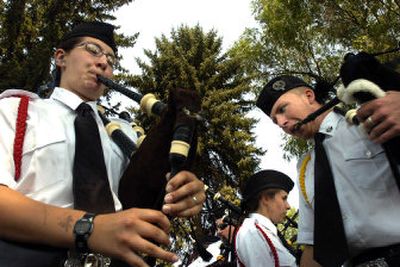
Mike Bird, of Spokane, had to be coerced into attending his first Highland Games on Saturday. A Scotsman by heritage, Bird relented this year when his wife, Susie, insisted they attend the annual event – the 48th Highland Games, hosted by the St. Andrew’s Society of Spokane.
Two hours into the day, Bird said it wouldn’t be his last.
Bird and about 1,500 other people had their choice of music, Highland dancing, sporting events and – naturally – some Scottish beer during a bonny afternoon at the Spokane County Fair and Expo Center.
Having bought a starter bagpipe earlier this year, Bird said he’s convinced it’s time to start taking lessons.
“It brings goosebumps listening to them,” he said as the 12-piece Desert Thistle Pipe Band from the Tri-Cities wailed through a set that included “Scotland the Brave” and “The Green Hills of Tyrol.”
There was plenty of piping, dancing and throwing of heavy objects, with kilts and woven wool socks in abundance. This was the first year that enough women athletes signed up to create a separate category for them in the Scottish games.
The youngest of the four women, 17-year-old Shannon Springer, a high school student from Salt Lake City, competed in all seven events, including the caber toss.
“You know if you’re doing the caber right if you have a bruised collarbone,” Springer said, pointing to the smudge on her T-shirt shoulder.
Each caber tosser throws a wooden pole weighing 70 to 100 pounds or more. When thrown correctly, the heavy top end of the pole flips back toward the thrower, while the lighter end rotates and lands flat. Each competitor gets three tosses, with the highest score given when the caber lands in alignment to the person throwing it.
“It doesn’t matter if you win or lose,” said Marius Artis, a Whidbey Island resident who began competing in Scottish sports events four years ago. Artis is one of the few African Americans competing in Highland games around the Northwest, and he’s proud of it.
“It was something that came from studying my family heritage,” said Artis. He learned he was part Scot when his family tree showed that his great-great-grandmother married a black man in Ohio.
Tyler Zuck and Tom Shrum, both originally from White Salmon, Wash., and now both attending Whitworth College, came to Saturday’s games at the invitation of a friend who had been a Highland dancer for several years.
Zuck said he was surprised at how much he enjoyed the events.
“When you look at modern athletes,” said Zuck, “what you see are people wearing modern clothing and high-priced shoes or equipment.
“But if you watch these people throwing those weights and poles, you know they’re part of a tradition going back a long way.”