
As talks stall, Israel ramps up attacks

BEIRUT, Lebanon – In one of the deadliest days of nearly a month of warfare, Israeli bombardment killed at least 61 people Monday in strikes on south Beirut, the eastern Bekaa Valley and southern Lebanon.
With diplomatic overtures for a cease-fire stalled, Israel vowed to expand its offensive. Prime Minister Ehud Olmert said he would place “no limits” on the army in its efforts to rid south Lebanon of Hezbollah militia fighters.
In south Lebanon, three Israeli soldiers from a tank crew were killed and seven injured during pitched battles with Hezbollah guerrillas, who again rocketed northern Israel with devastating effect.
The day’s heaviest toll was exacted when Israeli warplanes took aim after sunset at the southern Beirut neighborhood of Shiyah, flattening a crowded, six-story apartment building and sending debris flying for blocks. By midnight, at least 20 people had been found dead, Lebanese television reported, and the numbers continued to climb as rescue workers rooted in the rubble in search of survivors or bodies.
The late Monday attack came as a growing chorus of Israeli military figures acknowledged they have been unable to stop Hezbollah guerrillas and demanded a freer hand to move deeper into Lebanon.
Disagreement also mounted over a U.S.-backed United Nations draft resolution aimed at ending the bloodshed, which has killed nearly 800 Lebanese and 100 Israelis. Arab states said the proposed resolution gave unfair advantage to Israel, which is not required to withdraw or cease “defensive” operations.
Lebanon’s government on Monday said it would deploy a 15,000-strong army south of the Litani River if Israel withdrew from Lebanon, an important signal from Beirut that it will attempt to exert control over territory long ago ceded to Hezbollah. The government ordered army reservists called up in anticipation of the deployment.
Israel’s attack on the Shiyah neighborhood was especially terrifying because it was an area considered safe; refugees from bombings elsewhere had sought it out for safety. It is not part of the Hezbollah-dominated suburban band that rings Beirut’s southern edge.
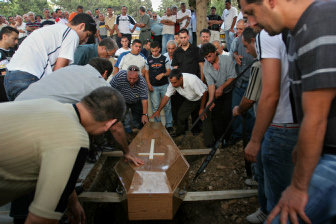
Details remained sketchy about airstrikes in the Lebanese border village of Houla, where Israel bombed a set of farmhouses where at least 150 people had taken shelter, according to people still living in Houla. Nearly 60 people emerged alive from the rubble, but the rest remained unaccounted for. Lebanese Prime Minister Fouad Siniora initially said the blast killed 40 people, but later revised the toll to one dead.
Elsewhere in southern Lebanon and in the Bekaa Valley, another 40 people were reported killed in air raids.
Division in Israel
A day after Hezbollah rockets killed 15 Israelis, a deepening divide between the country’s political and military leadership was in evidence.
Prime Minister Olmert, touring military command headquarters in the besieged north, said he will give the army free rein to press its offensive, regardless of diplomatic developments.
“We have to stop the rockets,” Olmert told reservist officers. “We cannot have a million residents living in shelters. On this matter, there will be no limitations on the army. … Israel cannot allow itself to let others think that … we will not punch them back in full force.”
Olmert’s comments may have been intended in part to stifle mounting criticism from senior commanders that they have felt restrained in mounting the ground war.
Olmert was accompanied by Defense Minister Amir Peretz, and both reportedly got an earful from field commanders who asked for greater leeway in moving through southern Lebanon to eliminate Hezbollah positions.
In response, Peretz said later he had ordered the army to broaden its attacks on Hezbollah rocket-launching sites “wherever they are.”
But criticism was growing among many Israelis as authorities acknowledged that Hezbollah still possesses thousands of short-range rockets, hundreds of longer-range weapons and 10,000 launchers, despite nearly a month of ferocious air, land and sea attack.
“At this point, we are in a war. We are bleeding,” said Maj. Gen. Doron Almog, retired head of the army’s doctrine and training branch. He said failing to deploy a larger ground force earlier and deeper was a critical mistake, for which Israel was now paying.