
Refineries OK for now
SEATTLE – Washington state’s largest refinery has access to enough oil stockpiles to keep things running normally for the next few weeks, but it likely would have to scramble for new sources of crude if any shutdown of BP’s Prudhoe Bay, Alaska, oil field lasts much longer than that, a BP spokesman says.
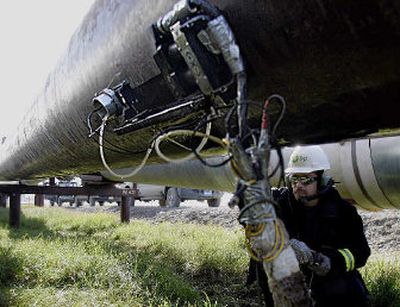
BP said Monday it has discovered corrosion so severe that it will have to replace 16 miles of pipeline at the huge Prudhoe Bay field – work that could shut down the nation’s single biggest source of domestic crude for months and drive gasoline prices even higher.
Mike Abendhoff, spokesman for BP’s Cherry Point refinery in northwest Washington’s Whatcom County, said the company is trying to determine whether temporary bypass lines can be used while corroded pipelines in Alaska are repaired or replaced.
“If they can’t do that, we need our folks to work hard on finding alternate sources of crude,” Abendhoff said.
BP PLC said it will have to replace most of the 22 miles of so-called transit pipeline at Prudhoe Bay, which produces about 2.6 percent of the nation’s daily supply including imports, or about 400,000 barrels a day.
The West Coast is expected to be squeezed particularly hard, and the government is considering releasing oil from its emergency stockpile to ease the crunch.
“If it’s an extended outage, there will be a certain amount of North Slope crude that we’re going to have to source elsewhere,” Abendhoff said. He added that BP would “look at all possible options to ensure that our stations and the people we supply aren’t significantly impacted.”
Most of the crude oil produced out of Alaska’s North Slope each day goes to refineries in Washington, California and Hawaii, which have a combined capacity of 2.7 million barrels of crude daily, said Joe Sparano, president of the Western States Petroleum Association, a trade group based in Sacramento, Calif.
About 60 percent of Alaskan North Crude goes to Washington, 36.5 percent to California and roughly 3.4 percent to Hawaii, said Suzanne Garfield, spokeswoman for the California Energy Commission.
Sparano said it’s too soon to tell how the shutdown will ultimately affect consumers. “Until we know the full extent of any necessary repairs and how long they might take, it’s impossible to predict what the impact might be,” he said.
BP Cherry Point gets about half its 230,000-barrel-a-day crude supply from the North Slope. Ten years ago, the refinery got all of its crude from Alaska, but has since diversified its supplies, Abendhoff said.
BP has enough oil stockpiles at Cherry Point, in Valdez, Alaska, and on tankers already bound for Washington to keep the oil field shutdown from becoming a major problem in the next two or three weeks, Abendhoff said.
“If it prolongs and goes six weeks, eight weeks, three months or four months, then it’s going to require us to be more creative in where we get our crude from,” he said.
Washington has four other refineries: two in Anacortes, one owned by Shell, the other by Tesoro; a ConocoPhillips refinery in Ferndale; and a U.S. Oil refinery in Tacoma.
In a statement e-mailed by company spokesman Gerald Baron, Shell said its Anacortes refinery, the second-largest in the state, gets a fluctuating percentage of North Slope crude but has enough supply on hand or en route to keep its operations running normally in the short term.
Tesoro said the BP shutdown would not have an immediate effect on its operations because only 10 percent of its crude supply comes from Alaska’s Prudhoe Bay.
Tesoro said it has a secure crude supply for its refineries in Anacortes and Martinez, Calif., for the next 30 to 45 days.
Calls to ConocoPhillips and U.S. Oil were not immediately returned Monday.