
Still along for ride
PITTSFORD, N.Y. – It’s been a good day, says Casey Martin.
The withered right leg that causes him to walk with a noticeable limp and one day may require amputation hasn’t bothered him much at all – meaning Martin has been able to concentrate on drives, chips and putts instead of wondering if the weakened limb will hold up long enough to complete 18 holes of golf.
“I have good days and I have bad days,” he said, during a break from a practice round Tuesday in preparation for this week’s Nationwide PGA Tour’s Xerox Classic.
“I never know how long the good times are going to last, so I savor every pain-free moment.”
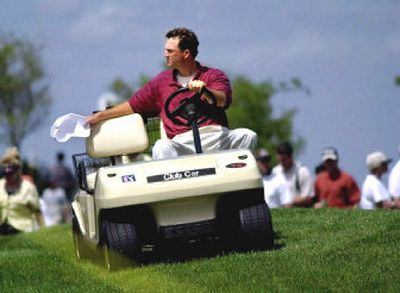
But even on a good day, like this one, Martin drives rather than strides down the fairway, relying on a motorized golf cart rather than his gimpy gait.
A cart has carried the 34-year-old around many a golf course.
Five years ago, it took him all the way to the Supreme Court.
The Justices ruled 7-2 in Martin’s favor that he could use a golf cart while playing in PGA Tour events. Some of the sport’s biggest names, including Jack Nicklaus, sanctimoniously lambasted the ruling, saying it would give Martin and other golfers with disabilities an unfair advantage because walking is an essential part of the game.
As it turned out, the sky did not fall and the game of golf was not irreparably compromised.
Plagued by the congenital circulatory disorder known as Klippel-Trenaunay-Weber Syndrome, Martin wound up spending just a few, non-descript years on the PGA Tour before losing his playing card.
Recently named men’s golf coach at the University of Oregon, he has limited his playing schedule to a select few events on the Nationwide Tour, a rung lower than the PGA.
“The last three years haven’t been real good,” said Martin, who failed to make the cut in his three previous starts this season. “My leg hasn’t been real great, and I just felt like it was time for me to look into new opportunities.”
He grew up a Ducks fan in Eugene, Ore., and when the chance to coach the hometown team presented itself, he jumped at it.
“I’ve just been recruiting so far,” he said. “We start up practices in about a month. I’m looking forward to working with kids and hopefully have a significant impact on shaping their lives.”
He’s already had a significant impact on so many others. While the PGA fought him in court and tour members either publicly criticized him or were alarmingly apathetic, Martin received reams of positive mail. The correspondence that touched him the most was from people with disabilities.
“That part of it has been very rewarding,” he said. “Hopefully, some kid who’s got a problem can see me and be encouraged that they can overcome it and still pursue their passion.”
That’s what it’s always been about for Martin. The two-time Stanford University All-American just wanted to play golf professionally. He never intended to become a cause celebre or have to deal with the suffocating media and fan attention that accompanied it.
“I was just like every other golfer out there,” he said. “I just wanted an opportunity to chase a dream.”
He did for a while, earning nearly $500,000 on the PGA and Nationwide tours. Now, he’s scaled back his play to sponsorship exemptions, such as the one he received this week.
“It’s been fun,” he said of the rollercoaster ride he’s been on since teaming with Tiger Woods to help Stanford win the 1994 NCAA golf championship.
“I could have done without a lot of attention that came with it, and I certainly wished I didn’t have the condition I have, but I can’t complain. I’ve had some great experiences out on the golf course, and – who knows? – maybe I’ll have a few more this week.”