
Terrorists planned to smuggle chemicals aboard, explode bombs in midflight, officials say
LONDON – The 24 British nationals arrested Thursday were in the final stages of an alleged plan to detonate liquid explosives on as many as 10 U.S.-bound airliners, in what appears to have been the most ambitious plot since the Sept. 11 attacks, British authorities said Thursday.
Officials could not say when the attacks were to be carried out, but said the suspects, mainly of Pakistani descent, had acquired many of the materials to assemble explosives that could have killed hundreds of airline passengers as their planes crossed the Atlantic Ocean from British airports.
“It was very near to execution,” said one U.S. official.
Pakistani officials made key arrests of British nationals in Karachi several days ago that apparently helped break a case they had been investigating for months.
The size of the operation and its international scope led government analysts to believe the plot was the work of al-Qaida or a related Pakistani extremist group.
“Quite simply, this was intended to be mass murder on an unimaginable scale,” said Paul Stephenson, deputy chief of London’s Metropolitan Police.
A British anti-terror official, who like others spoke on condition of anonymity because the investigation is ongoing, said the suspects planned to blow up as many as 10 U.S.-bound planes in waves of three over the mid-Atlantic. They had researched flight routes and determined that U.S.-bound jets tend to fly in batches toward their destinations, the official said.
“The planes would simply disappear and it would be impossible to recover forensic evidence needed for investigation,” the official said.
A senior FBI official said the group may have undertaken test runs, or may have been planning them. A U.S. intelligence official said information gathered thus far was vague and did not indicate firm time frames.
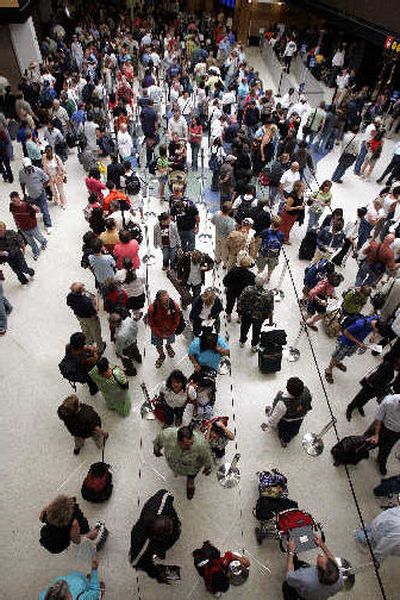
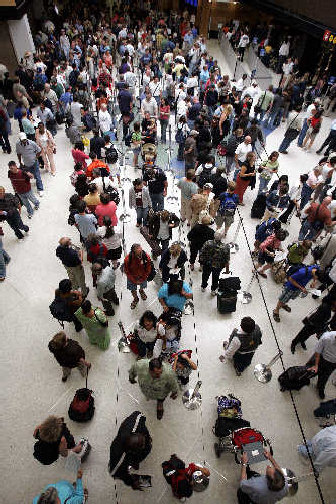
The arrests, made in Birmingham, London and High Wycombe, a commuter town west of the capital, were quickly followed by flight cancellations and an extreme security crackdown at nearly all major American and British airports, leading to delays and chaos throughout the world’s commercial airline system.
The plotters reportedly planned to smuggle chemicals aboard flights by hiding them in everyday items such as beverage containers, then assemble them into an explosive mixture and ignite or detonate them using common electronic devices, investigators said.
One FBI counter-terrorism official, speaking on condition of anonymity, said the men appeared to be using a heavily concentrated form of hydrogen peroxide and other chemicals available over the counter that could cause catastrophic explosions when combined.
“It’s all there on the Internet. Any chemistry student could create this sort of chemical explosion,” said the official.
The British anti-terror official said police found “plenty” of material that could have been used to make the explosives.
President Bush, who has been on a working vacation on his Texas ranch near Crawford, had known about the investigation for at least several days. He received “full briefings” about the alleged plot over the weekend and had two conversations about the imminent threat with British Prime Minister Tony Blair, said White House press secretary Tony Snow. One conversation came in a videoconference on Sunday.
After news of the terror plot became public, Bush went ahead with plans on Thursday to headline a GOP fundraiser near Green Bay, Wis., and tour a metal manufacturing plant. But he spoke about the plot while standing before television cameras on the tarmac in Wisconsin upon arriving, calling it a “stark reminder that this nation is at war with Islamic fascists who will use any means to destroy those of us who love freedom, to hurt our nation.”
Bush acknowledged airport restrictions would annoy travelers and urged patience. Officials at the U.S. Department of Homeland Security said they did not know when they would lift the airport security precautions, which were accompanied by a rise in official threat status to their highest levels in both countries.
Although authorities believe most of the plotters were apprehended in the late-night and early-morning raids, British officials said the tight security precautions were warranted until it becomes clear the entire network had been rounded up.
Some American officials fear that others may still be working to advance the airline plot.
“There are concerns that in addition to those who have been rounded up, there may be other individuals who might have been planning something along the same lines,” the U.S. intelligence official said. “That is something that is being aggressively pursued.”
Government officials said there was conflicting intelligence about how many planes and which airlines were involved, but most said nine or 10 aircraft reportedly had been targeted, while one counterterrorism official said there were 16 U.S. flights. They said the plotters may have been planning to operate in nine groups of about three each.
The British investigation, which was closely coordinated with American officials, had been under way for months. But Homeland Security Secretary Michael Chertoff said it was only in the last two weeks that it became clear American-bound flights on U.S. carriers from Britain were the intended targets.
While the flights were not identified, one U.S. official said the targeted airlines were American, United and Continental, which serve airports in Birmingham, London, Manchester, New York, Washington and California.
An FBI counter-intelligence official said the British government, still angered by perceived leaks of critical information related to last year’s subway bombings in London, was keeping a tight hold on some information, including which specific routes and destination cities were involved.
But the FBI official added their destination appeared irrelevant to the plot.
“It didn’t matter which (U.S.) cities they were headed to,” said the official. “They just wanted to blow them up in midair.”
The British anti-terror official said the attack was expected “within weeks.”
“It wasn’t imminent in the sense of the following day or the next day, but it would have taken place in the near future,” the official said.
It remained unclear what prompted British officials to move when they did. U.K. intelligence officials normally choose to gather intelligence on a suspected terror network for an extended period of time, in the hopes of discovering high-ranking backers.
British government officials would not say why they launched the series of raids Wednesday night, but a U.S. official said there was evidence the plan was accelerating in recent days. U.S. officials dismissed speculation that the plot was timed to coincide with the fifth anniversary of the Sept. 11 attacks.
“Terrorist plotters and planners execute when they have all the plot together, when they are satisfied it’s time to go,” said Charles Allen, head of intelligence at the Homeland Security Department. “We have no evidence this was timed to any particular holiday or any special event of any religious nature.”
The alleged plot resembles a foiled al-Qaida plan based in the Philippines to blow up 11 airliners as they crossed the Pacific Ocean to the U.S. from Asian airports in 1995.
It was credited to former al-Qaida operatives Ramzi Ahmed Yousef and Khalid Shaikh Mohammed, who would later become the accused mastermind behind the Sept. 11 attacks on the World Trade Center and the Pentagon.