
Jones facing ban
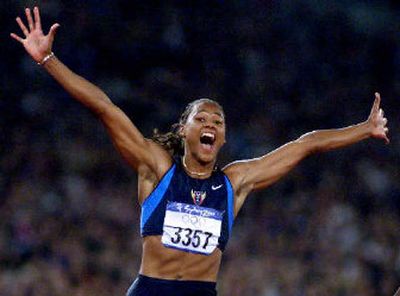

From the days when she was a little girl, pigtails flying, streaking past the older boys in her southern California neighborhood, Marion Jones has defined her life with speed. Outrunning the doping suspicions was her toughest race of all.
Now, perhaps, the game is over.
After years of denial, the five-time Olympic medalist has tested positive for a banned drug.
The “A” sample from the 30-year-old sprinter, taken after she won the 100-meter title at the U.S. track and field championships in June, showed the presence of the performance enhancer EPO, a person familiar with the results told the Associated Press.
If a second “B” test is positive, Jones could face a minimum two-year ban.
Doping suspicions have dogged Jones for years, but she has always vehemently denied using any performance-enhancing substances.
One of her loudest accusers is BALCO founder Victor Conte. In a 2004 TV interview, he said he designed a doping regimen, which included EPO, for Jones and watched her inject herself with steroids before the 2000 Sydney Games. She responded by filing a $25 million defamation lawsuit that was settled out of court.
But Saturday Conte again sought the last word.
“I have always told the truth regarding my relationship with Marion Jones,” he said in an email to the AP.
Messages left for Jones’ attorney Richard Nichols on Saturday were not returned.
“Marion Jones has always been clear, she has never taken performance-enhancing substances, not now, not ever,” Nichols said in a statement Friday to Reuters.
Now Jones, once the charming, dominating face of track and field around the world, must wait for the results of her backup sample to back up her words.
The positive test on the “A” sample was not for steroids, but for erythropoietin, also known as EPO, an endurance booster usually associated with distance runners. Only recently have sprinters been subjected to tests for the drug.
When former world 100- and 200-meter champion Kelli White told the U.S. Anti-Doping Agency that EPO was among the banned substances she had used, testing was expanded to sprinters.
Charles Yesalis, a doping expert and recently retired Penn State professor, said sprinters use EPO to expand their endurance during training.
“If you train harder, during that 10-plus seconds you will perform better,” he said, adding there is disagreement in the scientific community over whether EPO does sprinters any good.