
Some banks cut ATM fees to gain edge
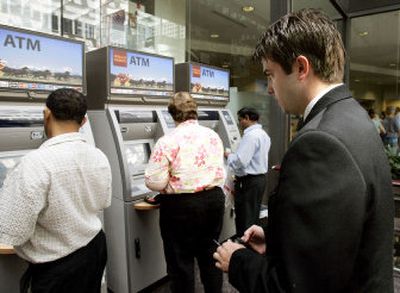
MINNEAPOLIS – Jay Gustafson, in an unfamiliar town for a job hunt and in need of some fast cash, gritted his teeth and hit the nearest ATM.
“For $20, I paid $25,” Gustafson said, bemoaning the fees levied by both the bank that ran the machine and by his own bank for using someone else’s machine.
Millions of Americans do the same thing every day, to the tune of an estimated $4.2 billion in ATM fees this year. But at a time when more banks are charging noncustomers more money to use their ATMs, some consumers are getting a break. Many credit unions and smaller banks are joining surcharge-free ATM networks to make up for not having large networks of their own to compete with national banks.
And one big bank, U.S. Bank, a part of Minneapolis-based U.S. Bancorp, expanded its network by buying the MoneyPass surcharge-free ATM network, giving its customers free access to 10,000 ATMs in 48 states, including 5,000 U.S. Bank-owned machines.
“We’re in a constant dog-eat-dog fight for market share,” said Rick Hartnack, U.S. Bank’s vice chairman and head of consumer banking.
Greg McBride, senior financial analyst with Bankrate.com, said U.S. Bank’s move “goes against the grain” of what other big banks are doing.
“This is a move to differentiate themselves from their primary competitors that have very large ATM networks themselves,” McBride said.
Bankrate.com projects that consumers will pay $4.2 billion in ATM fees this year, a slight dip from $4.3 billion last year, but McBride said the overall trend is upward.
The financial Web site’s latest semiannual survey found that ATM surcharges have soared more than 20 percent in the past two years. The fees banks charged to nonaccount holders averaged $1.60 this spring, up from $1.32 two years ago, and 98 percent of banks that own ATMs now charge fees to nonaccount holders, up from 89 percent two years ago.
One major bank that had bucked that trend gave up last fall. Seattle-based Washington Mutual Inc., the nation’s largest savings and loan, last November dropped its long-standing practice of allowing noncustomers to use its ATMs for free, citing long lines that made access harder for its own customers.
Bankrate.com said Washington Mutual was largely responsible for both the rise in banks charging fees to nonaccount holders in its latest survey, as well as a drop in banks that charge their customers for using other banks’ ATMs.
Bankrate.com said fees imposed by banks on their own customers for using other banks’ machines fell to $1.29 from $1.37 since last fall, and the number of banks imposing such charges fell to 81 percent from 89 percent a year ago.
Gary Townsend, an analyst with Friedman, Billings, Ramsey & Co., said most banks see charging fees to noncustomers as a “no-brainer,” an easy way to make money. But he said he sees a “distinct trend” of smaller banks offering their customers breaks on ATM fees to compete against the big institutions.
Over at the University of Minnesota, MBA student Christopher Wahrman said he’s irritated enough with how much he pays in ATM fees – as much as $50 a year – that he would consider switching from Wells Fargo if he could find a bank that offered free use of ATMs everywhere.
Until then, he said, he’ll just keep searching for his own bank’s machines.
“I’ve gotten better at it,” he said. “I used to get out of control.”
Bigger banks already have a competitive advantage with their large ATM networks, McBride said. Charlotte, N.C.-based Bank of America Corp. has the largest among the bank-owned networks at nearly 17,000 ATMs nationwide. San Francisco-based Wells Fargo & Co. owns 6,500 machines in 23 states.
But the country’s largest surcharge-free ATM network is Allpoint Network, which has 32,000 machines in all 50 states. All of them are in retailers such as Target and Costco discount stores, and CVS and Walgreens pharmacies.
Allpoint’s participants are mostly credit unions and smaller banks, said Ben Psillas, president of the Bethesda, M.D.-based network. Those institutions can then woo customers with the promise of 32,000 free ATMs, he said.