
Fires eat up resources
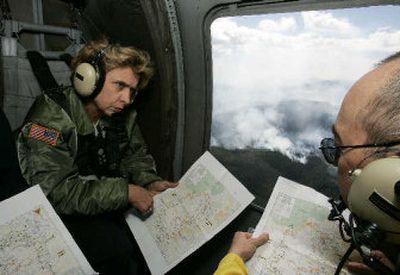
Wearing a yellow Nomex shirt and overlooking a sun-baked Spokane runway shrouded in smoke, Washington Gov. Chris Gregoire declared a statewide emergency Wednesday after fires threatened homes in Dayton, and flames continue to consume huge swaths of the Okanogan National Forest.
Using a Black Hawk helicopter, Gregoire, Public Lands Commissioner Doug Sutherland and Washington State Patrol Chief John Batiste visited the Flick Creek fire near Stehekin and lunched with some of the 3,000 firefighters fighting the 128,000 acre Tripod Complex fire near Conconully, located northwest of Omak.
“The end is not near. In fact that fire will not go out until winter puts it out,” Gregoire said of the Tripod fire.
The state’s top official didn’t have time to fly over Dayton, which the governor indicated was foremost on her mind.
The lightning-caused fire in Columbia County more than doubled in size to almost 40,000 acres, fire officials said Wednesday.
“As a result, today I will sign a state of emergency, indicating that all resources … be made available wherever a fire may start,” Gregoire said. “The best defense to any fire is … get it contained as soon as possible.”
The blaze in Columbia County caused the evacuation of the Dayton Hospital and Nursing Home, as well as 300 additional residents, but that number was expected to grow, officials said. Two homes and 10 other structures were destroyed by flames, and several other buildings were damaged Wednesday as the fire grew. About 550 structures remained threatened.
“The (Columbia Complex) fire continues to spread,” said Lisa Caldwell, a spokesperson for the Department of Natural Resources.
“Dayton, of course as you know, was the one that was of most concern early (Wednesday) morning. We are doing our best to contain that fire,” Gregoire said. “So I’m today going to ask that all available resources be given to any and every community that has one of these fires start.”
As part of her emergency declaration, Gregoire said she may call up to 500 members of the Washington National Guard to help with firefighting.
“From the air, you can see just how difficult a fire it is to fight,” Gregoire said. “The terrain is too rugged to put human lives in there to fight it. It’s a spotting fire. So while the firefighters may put a line to stop the fire, it can just readily jump a mile away.”
In Idaho, officials were unwilling to send crews to fight backcountry fires unless there was a guarantee of helicopter or airplane support. But with major fires burning in almost every western state, few aircraft were available.
“Resources are really starting to get scarce now,” said Gail West, spokeswoman for the Idaho Panhandle National Forests.
There was little progress in controlling fires burning along the Montana-Idaho border, as well as a cluster of six fires northwest of Priest Lake.
An estimated 100 firefighters have been assigned to the fires northwest of Priest Lake, but crews are only able to reach the fires by helicopter, parachute drops or long hikes. On Wednesday, one crew hiked into a 40-acre fire burning on Plowboy Mountain, about 10 miles north of Nordman.
Trail closures are being implemented in parts of the Colville and Panhandle national forests, including the Shedroof Divide, the Salmo River and Upper Priest River regions. Details on the closures are expected to be posted today on the Forest Service Web site, www.fs.fed.us/ipnf
In the Okanogan National Forest, the Tripod fire had threatened more than 800 structures, but few – if any – had burned.
The blaze started on July 24 as smaller lightning-caused fires joined together to burn more than 200 square miles of forest as of Wednesday, according to the Northwest Interagency Coordination Center. Gregoire said the fire almost exactly has followed the boundaries of diseased and dying trees.
The state has already spent more fighting fires than budgeted for the state Department of Natural Resources, she said. For example, crews have already spent $42 million fighting the Tripod fire of which about $4 million came from state coffers, she said.
“I will go back to the Legislature and ask for emergency funding if that is necessary. But we’ve got to fight the fires,” she said. “I’m not going to allow the budget limitations to strangle DNR’s ability to do the job they need to do.”
When asked if the state has done enough to manage the infected trees, Gregoire said: “I think we are going to debate that as a state and a nation for a long time. We are trying to manage the best we can. But the federal government is obviously going to have to visit the policy about what do we do about the standing timber that we know has an infected area.”
This summer has followed several recent summers of major fires draining on local resources, she said.
“We were very optimistic this year. We thought with the rainfall that it would curtail it,” she said. “In fact what it did was give it new fuel, which is very unfortunate. We are going to pray for weather conditions that will be favorable to all these” fires.
However, Gregoire does not remain hopeful of changes any time soon.
“As long as we continue to have the drought conditions that we do in the western part of the country, we are going to continue to see this, unfortunately, on an annual basis,” she said. “We just need to get ready, be smart and do what we can to stop it early before it expands.”