
Bird flu ties up fly-fishing business

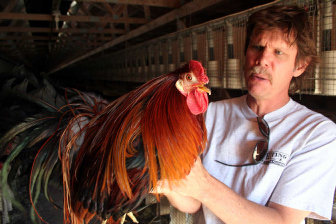
DELTA, Colo. – Lines of long, narrow, white buildings spread out across the ranch in the lush, green farmland of western Colorado. Inside are chickens, up to 85,000 in each of the dimly lighted coops with interiors that feel like greenhouses and smell like outhouses.
This is Tom Whiting’s lab, where he creates new kinds of chickens – or, more specifically, chicken feathers.
Whiting is no mad scientist. He’s a poultry geneticist, and his company, Whiting Farms, is the world’s largest producer of the chicken hackle that fly-fishermen use for tying flies. Whiting keeps a watchful eye on his birds, from the time the chicks are hatched until their feathers are packaged and shipped to companies in roughly 40 countries.
With the operation broken up among three ranches, Whiting has biological security from poultry diseases and protection from natural disasters that might wipe out his entire line. If anyone in the poultry business is going to be immune from avian influenza, it’s Whiting.
Still, the panic over this new strain of an old disease has reached his ranch on the Western slope of the Rockies – in the form of red tape.
“It comes in to be an impact in the hurdles, the hoops that we’re forced to jump through,” Whiting said from a room decorated with stuffed chickens and elaborate fishing lures sent to him by fishermen around the world. “It’s a moving target right now because nobody knows what it is, and the governments in every single country have their own requirements. And that’s created a lot of headaches.”
Bird flu was first documented in the 1800s. The latest strain was first discovered in 1997, when H5N1 was isolated from a goose in China. The virus began its global march in 2003, sparking hysteria that peaked with fears it might mutate into a form easily transferable among humans and start a pandemic. At least 141 people have died and the increased attention has led to misinformation that spread exponentially faster than the disease itself.
The small world of fly-fishing has been just as susceptible to the rumors. From blogs to fly shops, fishermen wanted to know the dangers of bird flu. Do you need to wear a mask when tying flies? Will I get bird flu if I lick the hackles to get them to lay down? Do I need to wash my hands after handling feathers?
Those in the know couldn’t believe what they were hearing. “I thought people were smarter than that,” said Karl Schmuecker, whose family owns Wapsi Fly Inc., a wholesale distributor of fly-tying materials in Mountain Home, Ark. “It’s impossible. The virus has to have a live host. You can’t even get it off the skins. None of the product here in the U.S. even had a chance to be infected, so it’s pretty ridiculous.”
Schmuecker’s right. Loose feathers and strung hackle – feathers that are plucked and sewn back together – are still allowed into the United States after they’ve been certified clean (steamed at high enough temperatures to kill the virus). That hasn’t affected the fly-tying industry much. What has is a USDA ban on importing feathers still attached to the skin from the three dozen or so countries where H5N1 has been detected.
It’s cheaper to buy feathers in China and other Asian companies, so that’s where most fly-tying companies do business. Since those countries are in the heart of the bird flu outbreak, the fly companies have had to search for other sources and it’s costing them – almost double what they used to pay for rooster necks and guinea skins.
And the higher overhead has been passed on to the fly shops and fishermen; Wapsi’s fall catalog will include some higher prices, though not everything will go up because the company stocks some products one to two years in advance.
But it’s not just higher costs that have hit the fly-fishing shops. Because of the increased scrutiny on imported feathers, shipments often get delayed. Unable to get feathers from their usual sources, some shops have had to switch vendors.
“A lot of the companies I deal with who import from the Asian countries are having trouble getting some of the feathers in – they get tied up for long periods of time,” said Grady Allen, owner of UpCountry Sportfishing in Pine Meadow, Conn. “When we’re looking for feathers, sometimes they don’t have what we’re looking for because they’ve been restricted, at least temporarily. So when I order them up, they’re just not there.”