
Trail leads you by tree full of shoes

If you’re looking for an interesting day or weekend trip before winter sets in, how about a drive to the west side of Priest Lake? A few miles north of Nordman is the Shoe Tree. It’s a giant cedar with hundreds of pairs of footwear adorning almost every square inch of the trunk. There are work boots, high heels, baby shoes, ski boots and slippers, not to mention plastic bottles with notes curled up inside.
These odd decorations are nailed to the tree from the ground, to a height so high, the donors could only have brought an extension ladder to reach. Others are tied together and flung into the limbs, dangling like Christmas ornaments.
The Shoe Tree left ordinary “treedom” in 1944 when the U.S. Forest Service sent a crew of high school kids, working through the summer, to the clearing surrounding the tree. The workers were there to pull up the currant and gooseberry bushes, which were acting as a host for a deadly tree disease called blister rust, that was killing the white pines in the area.
“There were about 40 of us kids in a tent camp,” recalls 79-year-old Emmett Mullaley of Priest River. “We’d swim in Huff Lake, run all over Stagger Inn, and uh, it was illegal, but we’d sneak angle worms in to Muskegon Lake and catch real nice cutthroat.”
At the end of the season, the crew packed up their gear. Seventeen-year-old Emmett held up his old boots and told his buddy from Wisconsin he wasn’t packing the ratty things home. He grabbed a spike and nailed them to the tree. The Midwesterner followed suit and they drove off without a clue as to what they had started.
Pair after pair of shoes were added to the tree, until literally hundreds clung to limbs and bark. If someone had told the two boys, one day thousands of families would have a photo of themselves in front of the tree, they would have laughed. Who could have predicted it? There’s also a trail called Tillicum Creek Trail that goes right past the Shoe Tree.
“Just up the Tillicum Creek Trail was an Italian POW camp,” said Mullaley. “They use to drive right by on their way up there and kept several prisoners.”
After visiting the Shoe Tree, drive a couple of miles further to the Roosevelt Grove of Ancient Cedars. It was first discovered in 1919 by a forester whose records show the average tree as 800 years old, and some more than 2,000 years old, 150 feet tall and 12 feet in diameter. He recommended that the grove be set aside and named after President Theodore Roosevelt. Several nice walking trails lead hikers on a scenic jaunt to the upper cedar grove.
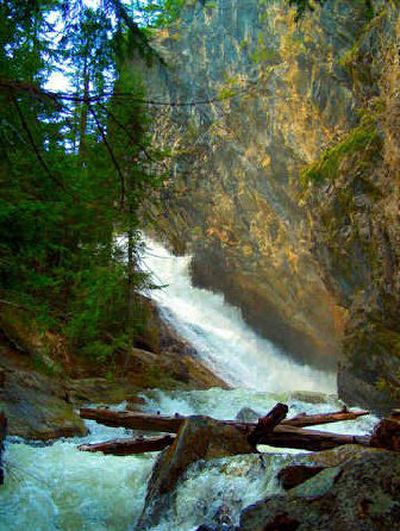
A short trail leads to Granite Falls, one of the most dramatic waterfalls in Idaho. In early summer, it’s loud and impressive and you don’t have to view it from afar; you’ll practically be standing in it. When you’ve had your fill, take the path to the viewpoint which hangs over the side of a cliff for a close-up look at the falls from above. There are several gorgeous smaller falls along the way and it’s only about two miles of walking if you take all the trails. Toward the end of summer the water slows but it’s still a great waterfall. A trip here at the beginning of June will have you gasping at the intense volume of water crashing down the sheer rock cliffs.
The area is almost untouched. You won’t find houses, power poles or pollution. What you will find is eye-popping scenery. Moose are often seen drinking from Granite Creek, if you’re alert enough to spot them. Signs are posted that it’s grizzly bear country, so you’ll want to camp responsibly.
The Stagger Inn campground has primitive campsites among the cedars and outhouses nearby. No water or power is available, but there are picnic tables, fire pits and a barbecue at each site. The campground is unattended and camping is free. In fact, this entire weekend getaway can be had for the cost of gas and a few groceries. But make this trip in the summer or early fall since Forest Road 302 isn’t maintained in the winter.