
Exit 289: Home is all that’s left of a grand dream
MOUNT HOPE – The future once rolled by Genesis and Scott Dashiell’s home at speeds approaching 35 mph.
It looked like a two-car passenger train decked out in wicker furniture and upholstered walls. The pantograph on its roof pressed upward against a high-voltage wire, which sparked the train to life.
The year was 1906, and for dirt-road towns without so much as electric lighting, the future always rolled in on iron wheels.
“The tracks were right here,” said Genesis Dashiell. She stares at the trackless ground before her door like someone looking for sandy footprints after high tide. “Those footings over there – that’s where the depot was.”
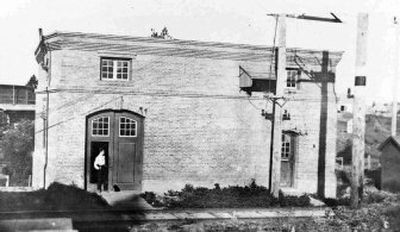
The Dashiells live in an old transformer station of the former Spokane & Inland Empire Railroad.
With red-brick walls 18 inches thick and roofs of solid concrete, transformer stations housed the equipment required to give the S&IE current a needed boost every 20 miles or so. The walls of the couple’s living room are pockmarked from sparks that once flew from transformers housed inside the building, though the hardware has been missing for decades.
Today at Mount Hope, where there are only a handful of homes and a lonely country chapel, the building is a reminder of a grand promise unkept.
The S&IE laid track from Spokane, where it had a booming streetcar business, all the way to Moscow, Idaho, and Colfax under the direction of its founder, Jay P. Graves, who was convinced the rail line would breathe life into – and even raise cities on – the Palouse. Graves, who had copper mines in Canada, an electric railroad in Spokane and real estate interests throughout the West, seemed to have the Midas touch. He also wasn’t afraid to spend money on a hunch.
“The fellow that built this railroad was gung-ho about everything being extra fancy,” said Glenn Leitz, a Palouse historian.
What impresses Leitz most is the spare-no-expense approach Graves took to building the railroad. He constructed the world’s longest curved wooden trestle over 1,360 feet of Rock Creek just to reach Mount Hope, which is west of Rockford. He built elaborate brick and stone depots with his-and-her waiting rooms and one-of-a-kind architecture despite most of the S&IE’s money coming from freight traffic. In between depots, the S&IE built bus-stop-style platforms where farm residents could be picked up.
A round-trip ticket to Spokane cost 84 cents. Once there, a person could pay 75 cents and travel by train all the way to Lake Coeur d’Alene or any of the smaller lakes along the way.
Leitz, 75, grew up on the edge of the S&IE tracks near Fairfield and still lives in the home where his parents homesteaded. The railroad brought an oasis of modernism to families who lived right along the tracks. To live next to the railroad meant having electricity in a part of the country where most people lived by candlelight and refrigerated with ice all the way into the 1940s.
“We had electricity in our home as long as I can remember,” Leitz said. “But 80 percent of our neighbors used candles for light. My mom had a refrigerator and a washer.”
Most of the towns along the rail line, Leitz said, expected to become metropolises.
But other machines were drawing a curtain on Palouse expansion and the S&IE almost from the beginning. Mechanized agriculture trimmed the manpower required to run a farm; the automobile usurped the train as the vehicle of the future.
Passenger trains were the first to go. Graves’ city passenger service in Spokane went into receivership in 1919, although passenger service continued on the Palouse into the late 1930s. After World War II, Great Northern controlled the old S&IE lines and had dismantled the Rock Creek trestle. Grain trains would stop in Fairfield and then back into Mount Hope.
The future was no longer interested in the tiny community.